
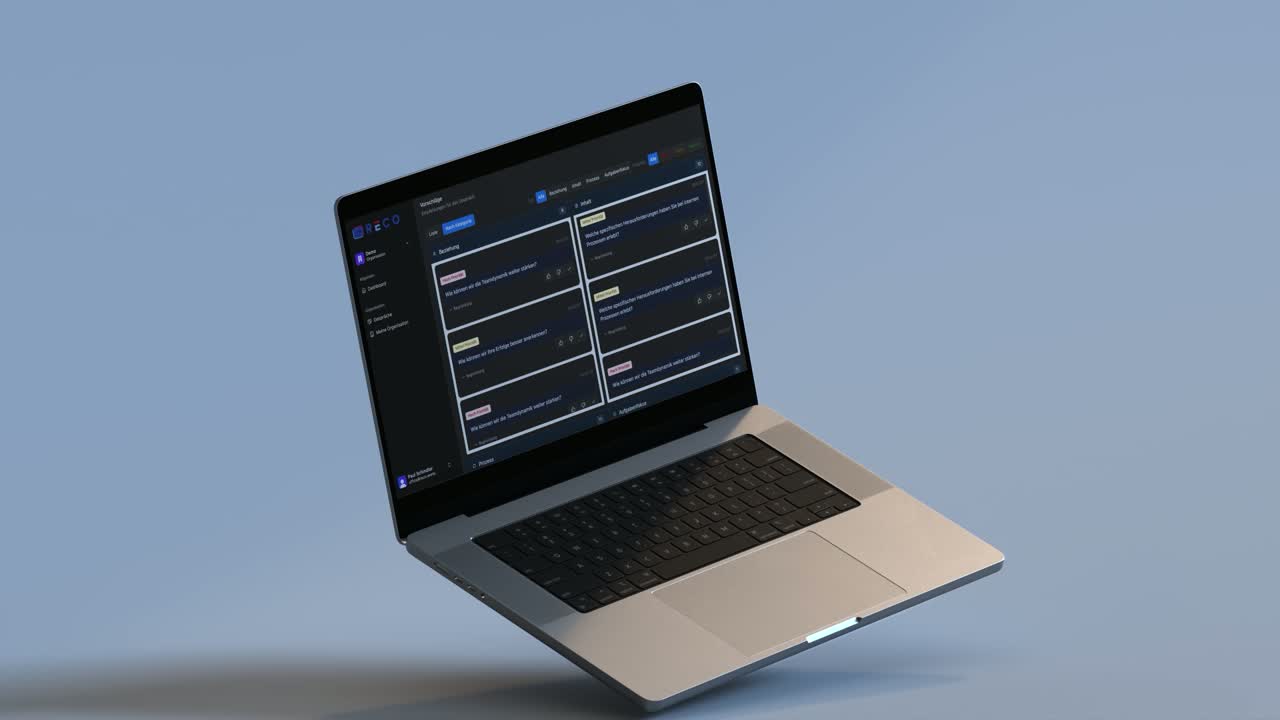
Your most valuable knowledge lives in heads, not in systems.
RECO documents what is said in your meetings and conversations, structures, verifies and turns it into a single, searchable knowledge asset, with zero manual documentation.
In cooperation with:



From practice
More than 10 years of AAZB training know how are documented with RECO, 92 percent of conversation content is searchable today.
Frictionless documentation
RECO documents your knowledge through conversation. No forms, no note-taking, no training required.
Knowledge you can trust
RECO verifies what it captures, by cross referencing your existing knowledge so your knowledge asset stays correct and current.
GDPR & EU-AI-Act aligned
Processed only on EU servers, with dedicated-server and on-prem options when you need to own it 100%.
The silent loss of knowledge
inside expertise‑driven SMEs
The knowledge that runs your business lives in your people's heads and leaves when they do. What knowledge stays behind is unverified and scattered across tools that are difficult to search
0M
Demographic shift
By 2030, 19.5 million baby boomers will be past retirement age, while only 12.5 million knowledge workers will stand to replace them. SMEs will and are losing people, expertise and critical know-how.
0%
Knowledge iceberg
Roughly 10% of critical company knowledge lives documented. The bulk lives as tacit, untransferred experience in people's heads and is lost when they leave.
0%
Knowledge transferability
62% of organizations identify poor knowledge-sharing as a direct cause of project failures. Resulting in repeated mistakes, siloed data and duplicated effort.
RECO is a knowledge‑infrastructure layer that turns what's said in your meetings and conversations into one verifiable source of truth. A company brain that compounds in value the longer it runs.
RECO runs seamlessly on laptop, tablet and smartphone.
How RECO works
Captures every conversation automatically
Meetings, decisions and commitments land in a searchable knowledge base automatically, with nobody taking notes.
Surfaces hidden operational waste
RECO spots duplicated work, open handovers and processes ready to automate, across teams and locations.
Grows into a lasting knowledge asset
Documented knowledge speeds up onboarding, prevents repeated mistakes and raises the value of your company.
Technology
Mid-sized SaaS company, 180 employees
€1.2M
per year
€1.2M
per year
High turnover in the engineering team caused knowledge loss and delayed releases. Structured employee conversations were largely missing.
Annual savings from reduced knowledge loss, based on turnover, ramp-up time and delayed releases.
Cost types
- Turnover 55%
- Rework and ops 25%
- Onboarding and offboarding 20%
Industry
Family-owned machinery manufacturer, 540 employees
€2.7M
per year, rework and ops
€2.7M
per year, rework and ops
Retiring foremen took decades of process know-how with them. Each replacement had to rebuild that from scratch, solving the same mistakes the previous person made.
Annual rework and operations costs avoided because process know-how stays documented instead of retiring with the foreman.
Cost types
- Turnover 20%
- Rework and ops 60%
- Onboarding and offboarding 20%
Consulting
International management consultancy, 1,200 employees
€6.5M
per year, onboarding and offboarding
€6.5M
per year, onboarding and offboarding
Onboarding and performance reviews were inconsistent. Young talent left early, each departure cost up to two annual salaries.
Annual onboarding and offboarding costs reduced because handovers run structured and knowledge stays in the company.
Cost types
- Turnover 25%
- Rework and ops 20%
- Onboarding and offboarding 55%
These scenarios are illustrative models. Your real numbers come from the calculator.
Brain Drain calculator
When knowledge walks out the door, the revenue follows. Use the calculator to model what generational change, turnover and undocumented know-how cost your company.
Open the Brain Drain calculatorRECOUse Cases
Document your meetings, decisions and processes and a company brain emerges. One searchable, verifiable source of truth that turns tacit knowledge into a real asset.
Faster onboarding & handovers
New hires and leaders get productive in a fraction of the time, because every decision, process and rationale is already documented and searchable.
Succession, sale & due diligence
A documented, searchable knowledge base cuts key-person dependency, so the business is easier to hand over, holds up in due diligence and is more attractive to successors and buyers.
Protection from key-person risk
When a key person retires or leaves, their knowledge stays. RECO captures the context, commitments and know-how in their head before it walks out the door.
AI-ready context layer
Executives query company knowledge through AI and your automations and agents finally have the structured context they need to actually work.
Searchable decision archive
Trace what was decided live, why and which risks were weighed, during and long after the meeting, so context is never lost and decisions hold up.
Meet audit and compliance obligations
Certifications, funding audits and the EU AI Act demand traceability. RECO records who decided what, when and on what basis, so evidence is available on demand instead of buried in inboxes.
One source of truth you can trust
Every decision, process and rationale reconciled into one searchable, verified knowledge base. So answers are consistent, current and trustworthy across the company.
Repeatable playbooks across teams
Turn what works in one team into a playbook every team can use, so processes become repeatable and the same mistakes stop resurfacing.
Build AI agents on your company knowledge
With a structured knowledge base underneath, specialized AI agents can take on operational tasks, prepare decisions and support employees in context.
Every team works from the same knowledge, the same truth
Critical know-how moves from one person's head to the whole company automatically. Teams cooperate easier and become more productive. Nobody burns time re-solving what someone already figured out.
- Cross team cooperation with one accessible source of truth
- Less rework and fewer expert interruptions
Document knowledge and processes before critical people retire
When an expert retires or leaves, their decisions, context and process knowledge stay in the business, so a departure costs you a clean handover and not months of reconstruction and painful onboarding.
- Key-person risk removed
- A clean handover, not months of rebuilding
A source of truth you never have to re-check
RECO verifies and updates the knowledge base with you as you're documenting, so your team stops paying to cross-check, reconcile and re-verify, so every decision runs on current knowledge you can trust.
- Stop paying to cross-check, reconcile and re-verify
- Decisions always based on current and trusted knowledge
A growing asset for your business and for your people
A knowledge asset that compounds with every session, makes the business a low flight risk, AI-ready and easier to hand over or sell.
- AI-ready without months of prep
- A knowledge asset that grows in value
Your benefits with RECO
What changes once your company's knowledge lives in one place, not in a handful of heads.
The people behind RECO
Expertise in conversation intelligence, technology and organizational development.

Mag. Paul H. Schindler
CEO
Leads RECO's strategy and brings mediation expertise into every product detail.

Markus C. Weiss, BSc
CTO
Owns architecture, AI models and the safe handling of sensitive data.

Viktoria Weigert
Creative Marketing
Sharpens RECO's brand, tone and positioning.

Konstantin Hofinger, BSc
Creative Marketing
Turns complex content into design that sticks.

Helen Röcker
Sales Partnership
Builds partnerships and guides companies through the first conversation.

Andrew Westfall
Sales Partnership
Opens doors to international clients and partner networks.

Simon Oberauer, MSc
Venture Relations
Positions RECO with investors, funding bodies and clients.

Stefan Kaiser, BA
Web Development
Supports customers from first contact through day-to-day operations.
RECO discovery
Every organization has its own dynamics, processes and challenges. That's why the journey with RECO always starts with a personal conversation.
A clear picture of where your knowledge is at risk
We go through which knowledge only exists in individual heads and what happens when those people are unavailable or leave. You walk away knowing exactly which roles, projects and processes run without a safety net.
The gaps that cost you most, made concrete
We estimate together how much time your team spends searching, asking around and redoing work, and what that really costs per year. A gut feeling becomes a number you can argue with internally.
Where to start, with RECO or without
You get a concrete recommendation on which area to tackle first and what a realistic first step looks like. Even if RECO is not the right fit, you leave with a plan.
What to expect in the conversation
We look at your current situation together
We identify where you can improve, with RECO or without
You leave with a clear next step and no obligation
Frequently asked questions
Everything about knowledge documentation, knowledge transfer and AI notetaking, answered briefly.
What is RECO?
RECO is a company brain. A knowledge infrastructure that documents the knowledge inside meetings and conversations, structures and verifies it and turns it into one searchable, AI-ready source of truth.
Who is RECO for?
Companies in the DACH region with roughly 50 to 500 employees where critical knowledge sits in a few heads, for example in manufacturing, industry, consulting, law firms or family businesses facing a handover.
How is this different from a wiki?
A wiki depends on someone volunteering to write. RECO is created as a by-product of conversations that happen anyway and it keeps the content current instead of letting it rot.
How fast can we get started?
Usually within a few days. One team starts documenting its recurring meetings and the knowledge base grows with every session.
What is a company brain?
A company brain is the organised sum of the knowledge a business creates: decisions, reasoning, experience and context. Unlike a file store, it captures why something was done a certain way and makes that retrievable for everyone.
How should a mid-sized company start with AI?
With one narrow use case that costs time every day. Meeting and knowledge documentation is a typical entry point: the benefit is measurable immediately, no data project is required first and the team gets to know the technology in a low-risk setting.
Why is knowledge documentation urgent right now?
Three trends collide: the boomer generation is retiring, turnover is higher than it used to be and AI systems are only as good as the data they can reach. Companies that leave knowledge unstructured lose it twice, in people and in technology.
What does RECO cost?
RECO is billed per user per month, in a package sized to your team. Because scope depends on user count, languages and integrations, we put the offer together in a call. The benchmark is the time your team spends today searching, asking around and repeating itself.
What is the difference between a company wiki and a company brain?
A wiki is a set of pages someone has to write and maintain. A company brain emerges from daily operations: from meetings, decisions and conversations. The wiki describes how things should work; the company brain records what was actually discussed and decided.
Which AI tools do mid-sized companies actually need in 2026?
In practice, three building blocks: an assistant for writing and research, a solution for meeting and knowledge documentation and search across your own content. Everything else only pays off once that base exists, because every further AI use case depends on well-structured company data.
Is RECO suitable for companies in Austria, Germany and Switzerland?
Yes. RECO is built for the DACH region: German-language processing including regional usage, European data processing, GDPR-compliant processes and experience with works agreements. Typical customers are knowledge-intensive companies with 50 to 500 employees.
At what company size does structured knowledge management pay off?
As soon as more than a handful of people work on the same topics, usually from around 20 to 30 employees. Beyond 50 it becomes critical, because informal alignment no longer reaches everyone and knowledge effectively lives in individual heads and inboxes.
How does knowledge transfer actually work?
Conversations, handovers and decisions are captured, structured and linked to their context. Individual know-how becomes shared knowledge that survives a departure.
Can tacit knowledge really be documented?
Not entirely, but far more than usual. RECO probes for reasons, exceptions and risks during conversations and surfaces what would otherwise stay in someone's head.
What happens when a key person retires?
Instead of months of reconstruction you get a verified handover: processes, decisions and the reasoning behind them are documented and searchable.
Is this a collaborative knowledge base?
Yes. Multiple teams work on the same body of knowledge, extend it and see the same verified version. Contradictions are detected and resolved instead of coexisting.
How do you make sure the content is correct?
New input is checked against the existing base. When something conflicts, the responsible person is asked before it is accepted as valid.
How do people find things later?
By asking questions in plain language instead of browsing folders. Answers come with source and date, so it stays clear what they are based on.
What is the difference between knowledge management and knowledge documentation?
Documentation is capturing content. Knowledge management is the process around it: capture, verify, structure, make findable and keep current. Documentation without process goes stale; process without documentation stays theory.
How do you secure knowledge when someone leaves?
Not during the notice period. If documentation runs continuously, most of it is already secured and the final weeks go into targeted handover conversations about open items, client relationships and exceptions. Those conversations should be recorded and filed in a structured way.
What makes a collaborative knowledge base work?
Three things: content is created as a by-product rather than extra work, every entry has an owner and search returns answers rather than hit lists. When a knowledge base fails it is rarely the software, it is that maintenance was designed as an additional task.
How do you break down knowledge silos between departments?
By capturing knowledge where it is already spoken and storing it centrally instead of in departmental folders. Shared vocabulary, cross-company search and permissions that make openness the default are what actually move the needle.
How can tacit knowledge and experience be documented at all?
Not through forms, but through conversation. Experience surfaces when people explain why they decided something in a specific situation. Those explanations already happen in meetings, reviews and handovers, so capture them there instead of asking for them afterwards.
How do you prepare for the succession of key people?
First make visible which topics depend on a single person. Then have those people document systematically over months, ideally in dialogue with their successors. Handover is a process across several quarters, not an appointment in the final week.
What does demographic change mean for knowledge in mid-sized companies?
As the boomer generation retires, decades of experience leave the business, often within a short window and without documented handover. Manufacturing, engineering, consulting and administration are hit hardest, because knowledge sits with people rather than processes.
Why is structured knowledge a prerequisite for AI in the enterprise?
AI answers are only as good as their sources. If information is scattered, contradictory or outdated, even the best model produces unusable output. A verified, current knowledge base is the real prerequisite for any internal AI assistant.
How much time does good knowledge documentation take?
Too much, if it is organised as extra work, which is why most initiatives stall. If documentation is a by-product of conversations that happen anyway, what remains is review and approval, typically a few minutes per meeting.
Is RECO just an AI notetaker?
No. A notetaker gives you transcripts of who said what. RECO reconciles every session into one verified, queryable knowledge base. The transcript is only the starting point.
Does RECO replace our current AI notetaker?
In most cases yes, because minutes and knowledge building happen in one step. Existing transcripts can be imported rather than lost.
Does it handle dialect and technical terms?
Yes. RECO is built for German-speaking business reality, including Austrian usage, domain vocabulary and mixed-language meetings.
Do we still get minutes and action items?
Yes. Summary, decisions and open points are generated automatically and stay linked to the underlying knowledge.
How does an AI notetaker work?
It joins a meeting or processes its recording, transcribes the speech, attributes statements to speakers and produces a summary, decisions and action items. The real difference comes afterwards: does the output land in a document, or in a searchable knowledge base?
How accurate is AI transcription for German and regional dialects?
With a clean recording, modern models are highly accurate, including Austrian and Swiss usage. What matters is microphone quality, custom terminology lists and a model trained for the language region. RECO uses specialised speech models for this.
What should you look for when choosing an AI note-taker?
Language quality in your own language, hosting location and data processing terms, how consent is handled, integrations with your existing tools and whether content stays searchable long term instead of being emailed out as minutes.
Does it work with Teams, Zoom and Google Meet?
Yes. Online meetings on the common platforms are processed, as are in-person conversations via recording. The important part is that results converge in one place rather than sitting separately per platform.
How good are automated meeting minutes really?
For decisions, tasks and commitments they are now highly reliable. They are weaker on nuance and prioritisation, so a short human review still makes sense. The time saved comes from nobody having to take notes and write them up afterwards.
Can in-person meetings and shop-floor conversations be captured too?
Yes, via an on-site recording. A decent microphone and informing everyone involved are what matter. In production, engineering and field service especially, a lot of knowledge lives in conversations that never happen in an online meeting.
Does it work for multilingual teams?
Yes. Conversations can be held in one language and the results read in another. For companies with international sites or mixed-language teams this is often the fastest way to make knowledge genuinely accessible to everyone.
What is the value of making meetings searchable?
Questions like "what did we promise the client in spring?" get answered in seconds instead of by asking around. Individual minutes turn into a searchable body of knowledge that grows with every conversation.
Where is our data stored?
Everything is processed on EU servers. RECO offers a dedicated server in Germany and on-premise deployments are available.
Is RECO GDPR compliant?
Yes. RECO is GDPR and EU AI Act aligned by design.
Is our content used to train AI models?
No. Your content stays yours and is not used for third-party model training.
How are access rights handled?
Roles and visibility are configurable per area, so sensitive topics stay limited to the people who should see them.
How do we handle employee consent?
Transparency is part of the rollout. Recording and purpose are communicated openly and we support you with works council agreements and internal communication.
What does the EU AI Act mean for mid-sized companies?
Most productivity applications fall into the low-risk category and mainly require transparency, such as informing people that AI is used, plus basic AI literacy in the workforce. Documented processes and traceable decisions make any later proof far easier.
Where is the data stored?
Processing takes place in European data centres, under a data processing agreement, with encryption in transit and at rest and clearly defined deletion periods.
What about works councils and employee representation?
Recording and analysing conversations requires co-determination as soon as it could enable performance or behaviour monitoring. A works agreement covering purpose limitation, access rights, retention periods and an explicit exclusion of performance monitoring is the proven route.
How do you handle confidential topics in conversations?
With clear rules on which meetings are documented and with content-level permissions. Sensitive topics such as HR matters, M&A or litigation are deliberately excluded or restricted to a narrowly defined group.
Does everyone in a meeting have to consent to recording?
Yes, transparency is mandatory: everyone involved must know that the conversation is recorded and analysed and be able to object. In practice a note in the invitation, a visible indicator during the meeting and a company-wide policy work well.
What does digital sovereignty mean for mid-sized companies?
Control over where data sits, who processes it and whether you could switch vendors without losing your knowledge base. In practice: European processing, clear contracts and the ability to export your own content.
Is our content used to train AI models?
No. Company content is not used to train general models. It is used solely to process and answer questions within your own organisation.
Does RECO work with our existing tools?
Integrations with MS Teams, Confluence and OneDrive are on the roadmap, so knowledge and action items land where your teams already work.
How much effort does this create for our team?
Very little ongoing effort, because documentation emerges from meetings that happen anyway. No extra writing work is added.
What if people don't play along?
Adoption follows usefulness. We start with one team that benefits quickly and make results visible before rolling out more broadly.
How do we measure the benefit?
Fewer repeat questions, shorter onboarding and faster handovers. Our brain drain calculator gives you a first estimate.
What does a sensible pilot look like?
One team, one clearly defined meeting type, six to eight weeks. Success criteria are agreed upfront, for example shorter follow-up work or fewer repeat questions. Then you expand to the areas where the same kind of knowledge is created.
How do you get the team to actually use it?
By reducing effort rather than adding it. When minutes appear automatically and search answers faster than asking a colleague, adoption takes care of itself. Visible use by leadership and a clear rule on which conversations get documented help.
Which metrics show that knowledge management is working?
Time to productivity for new hires, share of successful searches, time spent on meeting follow-up, number of questions routed to key people and the number of topics that only one person can cover.
Isn't ChatGPT or Copilot enough?
General assistants know the internet, not your company. They cannot tell you why a proposal was rejected in 2024 or what was promised to a client. RECO provides exactly that layer and can serve as a knowledge source for those assistants.
How long does it take to introduce a company brain?
Technically, getting started takes days. The organisational side decides the timeline: which conversations get documented, who reviews, who has access. Six to twelve weeks to steady operation in the first teams is realistic.
How do you calculate the ROI of knowledge management?
Through avoided cost: shorter onboarding, less duplicated work, fewer repeat questions and lower follow-on cost when people leave. Our Brain Drain Calculator gives you a first estimate using your own numbers.
Can RECO be integrated with existing tools?
Yes. RECO is designed as a knowledge layer on top of existing systems and works alongside common meeting, communication and storage tools rather than replacing them. Which connections make sense depends on your system landscape.
Why do knowledge management projects fail so often?
Because they are introduced as a documentation duty rather than a relief, because ownership is missing and because search returns no useful answers. Solve those three and you have avoided most of the usual pitfalls.
How do you build AI skills across the team?
Through real tasks rather than abstract training. One concrete use case, clear rules on handling data and people who are approachable day to day beat one-off workshops. The EU AI Act also expects basic AI literacy from everyone using these systems.
Case study: AAZB GmbH
How AAZB GmbH uses RECO to make knowledge from training, consulting and internal processes usable for the long term.
AAZB, Akademie für angewandte Zukunftsbildung GmbH
For over ten years, AAZB has trained coaches, consultants and trainers. With RECO, their meetings, jour fixes and stand‑ups are captured, structured and turned into a searchable knowledge base. A digital memory for the whole academy and the structured foundation they need to build AI agents on top of.
10+ years
of document training know‑how
92%
of searchable conversation content
Faster
employee onboarding