
AI budget 2027: which items to plan for and which to cut
 Mag. Paul H. SchindlerCEO, RECOPublished Last edited 6 min read
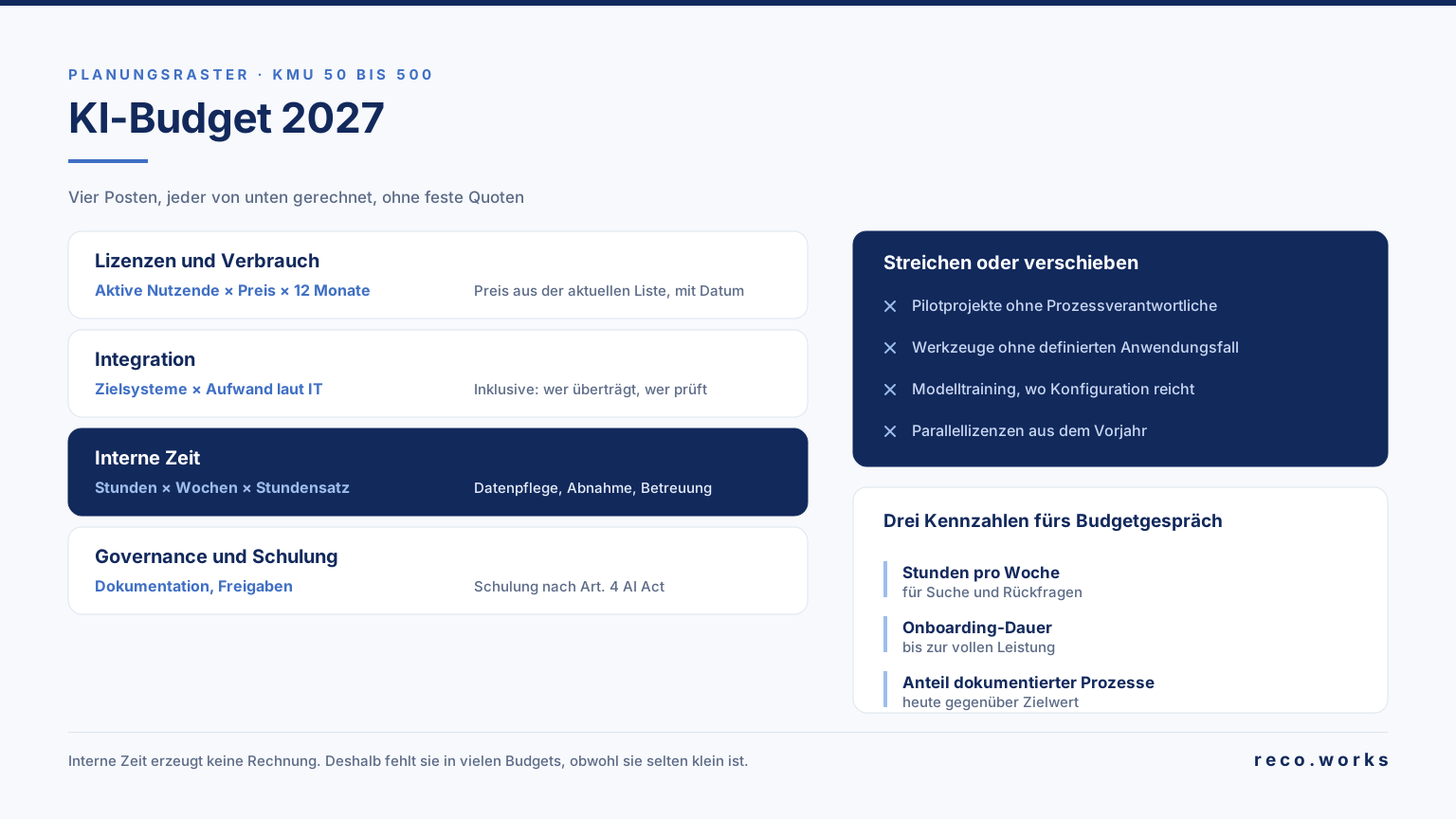
It's budget season for 2027, and somewhere in the spreadsheet there's a line labelled AI. Usually it's a license figure, sometimes with a little buffer on top. In most SMEs I'd call that line too low and split the wrong way. It covers what you buy. It leaves out the work your own people have to do. The failed AI project explains why the knowledge foundation deserves its own budget. Budgeting for knowledge preservation and knowledge transfer means reserving staff time to capture operational rules and help colleagues apply them, rather than funding licences alone.
Finance usually pushes back here, and the objection is fair. Internal time is already paid for, so why put it in a project budget? Paid, yes. Available, no. Every hour a team lead spends checking AI output is an hour taken from something else. If that hour isn't in a plan, it gets cut wherever the cut is least visible, which in my assessment is usually the support for the new tool. Usage drops, and by autumn someone concludes the licenses didn't pay off.
Four items that belong in an AI budget line
Licenses and usage are easy to forecast, because vendors publish their prices per user per month or per unit of usage. In my view they are rarely the biggest block. Budget per use case that's actually in production, and pay for active use rather than headcount. Licenses for people who never open the tool are the most reliable way to burn money.
With integration, the effort rarely sits in the technical connection. It sits in the processes around it. Say the output of an AI assistant is supposed to land in your CRM, your ERP or your personnel files. Someone then has to decide who transfers, checks and fixes what. That's a project with its own workload. As a side job for IT, it won't get done.
Internal time is the item people forget most easily, because nobody ever invoices you for it. That means keeping data clean, reviewing output and supporting users through the first few months. I can't honestly give you a fixed ratio to the license cost; I don't know of any solid data that would support one. Budget the item explicitly anyway, in hours and with names attached. I'd call it the biggest item in most cases and the one most often forgotten. Leave it out entirely and you're planning a project that works on paper and fails in practice. You can measure whether a tool is really being used, and I explain how in Introducing AI is not an IT project.
That leaves governance: documenting the systems in use, roles, approvals and training. Since 2 February 2025, Article 4 of the AI Act has required providers and deployers of AI systems, which includes companies that simply use them, to take measures on their staff's AI literacy. What that means in practice for smaller firms is covered in our piece on the EU AI Act for SMEs. Governance still isn't a big block if it runs alongside from day one. It gets expensive when someone has to piece together a year later who approved which system for what. This is budgeting guidance, not legal advice.
A template to check your numbers against
I'm deliberately not suggesting fixed percentages for the split. A ratio with no data behind it would distort your plan more than it would test it. Instead, build each item from the bottom up, one use case at a time:
- Licenses and usage: active users × price per user per month × 12, plus usage under the vendor's billing model. Take the price from the current price list and note the date, so the figure can be checked later.
- Integration: the systems the output needs to flow into, each with the effort your IT team or service provider quotes for it, including agreeing who transfers and checks what.
- Internal time: weekly hours of the named person looking after the tool × working weeks × internal hourly rate, plus the time users spend reviewing output. Your payroll gives you the hourly rate. For reference, Germany's Federal Statistical Office puts average labour costs at EUR 45.00 per hour worked in industry and services for 2025.
- Governance and training: hours for documentation, approvals and Article 4 training, again at your hourly rate.
The weekly hours of the person looking after the tool are the number missing from many spreadsheets. Don't take them from a rule of thumb. Ask that person how many hours a week they can realistically free up, and ask their manager which task they'll drop to make room. If you can't put a name next to those hours, the item only exists on paper.
Then look at how the four items compare. If internal time comes out as the smallest, I'd go through the plan again. That's my judgment, not a measurement. A tool nobody has budgeted time to look after rarely gets looked after properly.
Where you can cut
There are three places to save, and none of them hurts.
Drop tools that have no named process. If nobody can say which recurring task the tool handles and who checks the quality, it will never reach day-to-day operations, however good the demo looked.
Skip company-wide licenses in year one. Start with the department that has the most repetition, and expand once usage is proven. Get it in the contract that you can reduce the number of seats after an agreed ramp-up period.
On training, I'd cut anything that explains tools rather than use cases. I don't expect much from a short tool training. Guided work on real cases that have to be done anyway does more. It also covers the Article 4 literacy requirement better, because people learn where the system gets things wrong in their own work.
The item many budgets leave out
One item I'd add is the knowledge base underneath. If your decisions, client histories and project rationales live only in people's heads and email threads, you're paying for answers built on half the data. I'm not neutral here, because this is what RECO works on. Still, I think building that base through AI-supported conversation documentation gives you the best ratio of cost to effect in the whole budget.
The Akademie für angewandte Zukunftsbildung (AAZB) shows the order I mean. For more than ten years it has trained coaches, consultants and trainers, and it now captures its meetings, jours fixes and stand-ups with RECO. The result is a searchable knowledge base, and the AAZB is building AI agents on top of it. Knowledge first, agent second. Why agents without that context so often get stuck at the pilot stage is covered in AI agents in mid-sized companies. For a rough idea of what the current gap costs you, try the knowledge loss calculator.
One last test for your spreadsheet. If your AI line is almost nothing but licenses, something is missing, and most of the time it's your own people's hours. More on choosing and rolling out tools in the topic hub AI for mid-sized companies.
Sources
Frequently asked questions
How much should an SME budget for AI in 2027?+
There's no sensible flat figure, because the amount depends on how many use cases actually go live. Work from the first one, using the four items from the template: license price from the current price list, internal hours with names and an hourly rate, integration and governance at the quoted effort. The total is your budget for that one use case. Budget further use cases only once the first one is demonstrably in use, and then with the figures you actually measured on the first.
Which budget item is forgotten most often?+
Internal time. A quick test shows whether it's really planned. Assign the hours to a named person and ask their manager which task they'll drop to make room. If nobody can answer, the item has been written down, not planned.
Where can AI budget sensibly be saved?+
The easiest lever is licenses for people who aren't actively using the tool once the ramp-up period is over. Agree at purchase that you can reduce seats after a fixed period, and ask the vendor to show you where you can see active use per person. I wouldn't save on internal support time, because that decides whether the remaining licenses get used at all.
Related articles
In a 30 minute software demo we show you how RECO secures and transfers knowledge in your company. Request a demo now and we'll get back to you with a proposed time.