
Documenting employee conversations: what is allowed, what needs consent, what belongs in the file
 Markus C. Weiss, BScCTO, RECOAugust 27, 20268 min read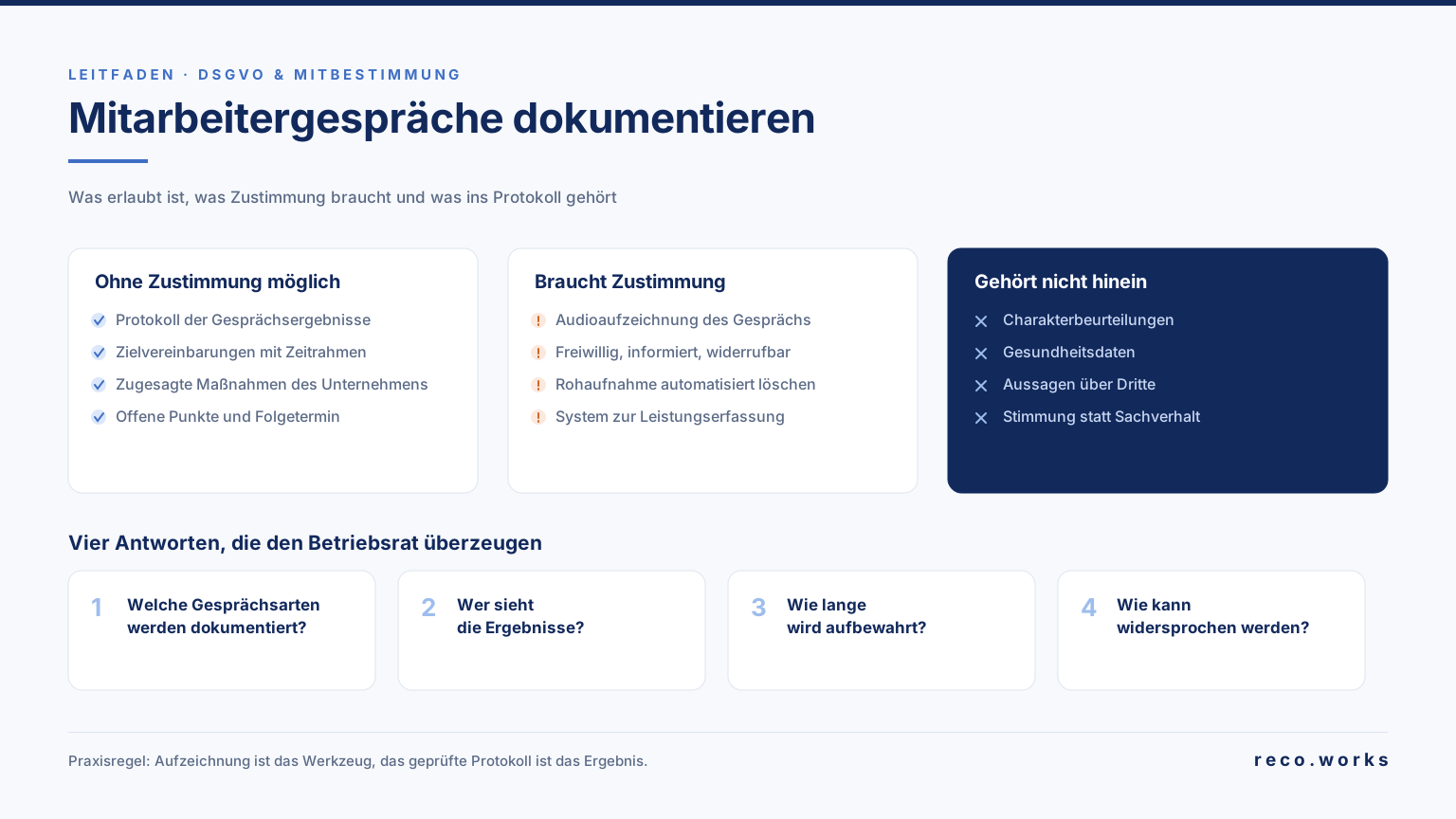
The most common question we get from HR teams is not which tool is best. It is: are we even allowed to do this? The subject is documenting employee conversations, meaning annual reviews, feedback sessions, goal setting and sometimes conflict resolution. The uncertainty makes sense, because data protection, employment law and co determination all meet here. The good news: the rules are clearer than the gut feeling suggests.
Start with the key distinction. An audio recording of a conversation is something different from documentation of its outcomes. A recording is an intervention that needs transparency and a legal basis, in practice informed and voluntary consent from both sides, documented and revocable at any time. A written record of results, on the other hand, has been standard practice in nearly every company long before any software existed.
That leads to a simple rule of thumb: make the recording the tool, not the result. Recording in order to produce a structured protocol within minutes, then deleting the raw audio automatically, keeps you in clean territory. Storing raw recordings indefinitely accumulates risk.
What belongs in such a protocol? Agreements made, concrete goals with timelines, commitments by the company, open points and a follow up date. What does not belong? Character judgements, health data, statements about third parties and anything that describes mood rather than fact. A good test is whether a sentence would still hold up if the person concerned read it two years later in a different context.
Equally important is review in practice. A protocol the employee has seen, commented on and confirmed is far more robust legally and, more importantly, it changes the conversation itself. When both sides know a jointly confirmed text will exist at the end, people phrase things more concretely.
On co-determination: as soon as you introduce a system capable of capturing behaviour or performance, the works council must be involved in Germany (section 87(1) no. 6 BetrVG) and a works agreement is required in Austria (section 96(1) no. 3 or section 96a ArbVG). That is not an obstacle, it accelerates things if you engage early. In the projects that moved fast, a one page paper was on the table after the first meeting: which conversation types get documented, who sees the results, how long are they retained, how can someone object. Those four answers resolve most concerns.
Retention should be a deliberate choice too. Goal agreements typically live for one cycle plus a follow up cycle. Notes from conflict conversations usually do not belong in the personnel file, they belong in a separate, tightly restricted case. And anything nobody needs any more should disappear automatically, not through discipline but through a deadline in the system.
Why this matters more now: documentation is no longer only about traceability, it has become the foundation of every further digital step. Capture knowledge from conversations in a structured way and you no longer lose it when someone leaves. You can estimate the size of that loss with our knowledge loss calculator. How the technical side performs in German speaking markets, meaning dialect, jargon and noise, is broken down in Speech to text 2026. And how to run the rollout as a change process rather than a tool launch is covered in Introducing AI is not an IT project.
The practical entry point is small. Pick one conversation type, usually the goal setting review. Define a template with five fields. Set retention and access rules. Collect consent in writing. And check after eight weeks whether the protocols actually get read. If they do not, the problem is not the law, it is the template. More on this in the topic hub Leadership and HR and under AI supported conversation documentation.
Sources
Frequently asked questions
Are employee conversations allowed to be recorded?+
Yes, if both sides give informed voluntary consent, that consent is documented and can be withdrawn at any time. It is advisable to use the recording only as an intermediate step towards the protocol and delete it automatically afterwards.
What belongs in a conversation protocol and what does not?+
Include agreements, goals with timelines, committed measures, open points and a follow up date. Leave out character judgements, health data and statements about third parties.
Does the works council need to be involved?+
As soon as a system is capable of capturing behaviour or performance, yes. In practice a one page summary of conversation types, access, retention and objection rights is enough to start the discussion.
Related articles
In a 30 minute conversation we'll discuss how and why RECO can grow your business now and into the future. Schedule a meeting now.