
What does it really cost when a key employee resigns?
 Andrew WestfallSales Partnership, RECOSeptember 29, 20267 min read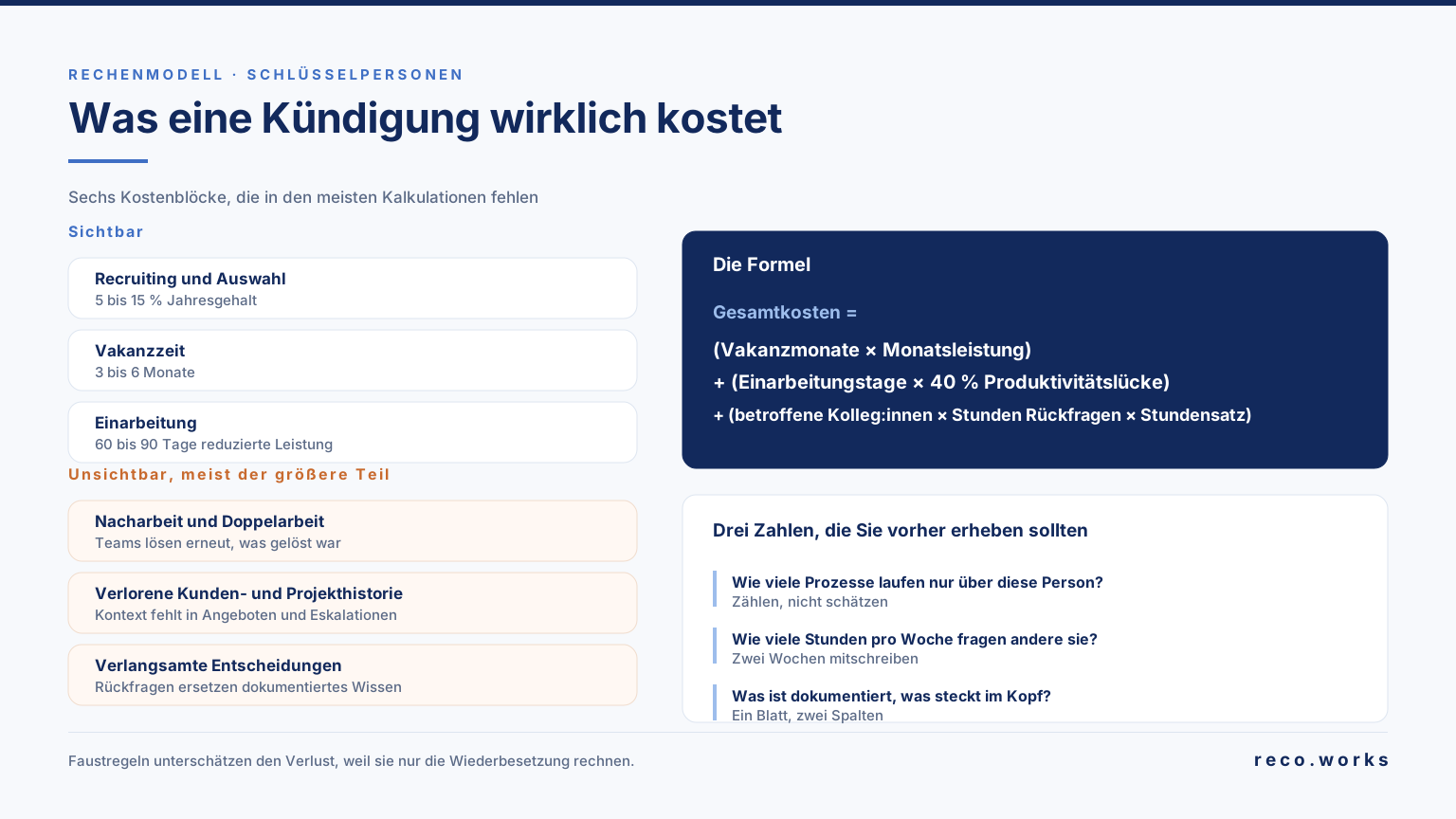
When a key person resigns in a company with 200 employees, a number usually appears very quickly. It sits somewhere between half and one annual salary, usually quoted as a rule of thumb and roughly the range Gallup and SHRM put on the visible costs. That number is not wrong, it is simply incomplete, because it mostly contains the visible costs.
The visible costs are easy to list: job ads, recruiters, internal time for interviews, onboarding, ramp up time with reduced productivity and possibly interim external support. All of that can be quantified cleanly, and most companies do exactly that.
The invisible costs sit elsewhere and are almost always larger in total.
The first item is rework. As soon as someone leaves who knew a process, questions start. Colleagues search for documents, reconstruct decisions, call customers to clarify things that were settled long ago. Expect several hours per week spread across several people during the first three months. It looks small and adds up to a five figure amount very quickly.
The second item is lost customer history. In many SMEs a single person knows the backstory of a major account, including commitments, exceptions and informal arrangements. When that person leaves, the relationship does not deteriorate immediately, but response times grow and mistakes accumulate. The commercial effect often shows up two quarters later.
The third item is slower decision making. Teams missing the reasoning behind past decisions decide more cautiously. They gather extra opinions, postpone, re examine. That delay is rarely dramatic, but it costs margin because projects start later and quotes go out later.
The fourth item is almost always forgotten: the quiet knowledge drain before the resignation. Disengagement is rarely a sudden decision, it often builds over months. According to the Gallup Engagement Index Germany 2025, 13 percent of employees have already mentally quit. During that phase less gets documented, handed over and shared. The loss begins long before the last working day.
So how do you calculate it? Take three figures: the affected role with its gross annual salary, the number of people who regularly rely on that knowledge, and the average extra time those people spend searching and asking after the departure. Multiply conservatively and use a horizon of six months, not six weeks. Then add the classic replacement costs. In nearly every calculation we have run with customers, the result lands at two to three times the original rule of thumb.
If you need a first order of magnitude without a spreadsheet, use our knowledge loss calculator. It shows how turnover, rework and onboarding split for typical company sizes.
More interesting than the number is the conclusion. If the most expensive part of the loss is not replacement but missing reasoning knowledge, then the lever is not recruiting, it is ongoing documentation. Not as an obligation, but as a by product of conversations that happen anyway. That is exactly where AI supported conversation documentation comes in.
The pragmatic first step costs nothing: list the five roles whose departure tomorrow would cause real damage. For each, check whether anyone besides that person could explain the last ten significant decisions. Wherever the answer is no, you have found your risk. More in the topic hub Knowledge management.
Sources
Frequently asked questions
How high are the costs of a resignation in a mid sized company?+
Once rework, lost customer history and slower decisions are included, the result is usually two to three times the common rule of thumb of half to one annual salary.
Which cost items are usually overlooked?+
Rework during the first months, lost customer history, slower decision making and the quiet knowledge drain in the months before the formal resignation.
How can knowledge loss be avoided?+
By documenting reasoning knowledge continuously as a by product of existing conversations rather than only at handover. What matters is capturing decisions with their context, not just outcomes.
Related articles
In a 30 minute conversation we'll discuss how and why RECO can grow your business now and into the future. Schedule a meeting now.