
AI note-takers under the GDPR: a buyer's checklist for Teams, Zoom, Meet and in-person meetings
 Markus C. Weiss, BScCTO, RECOPublished 8 min read
A sales director connects his calendar to an AI note-taker and ticks "join all meetings automatically". From that moment on, a bot with a microphone sits in every customer call, every job interview and every team meeting he is invited to. Even when he doesn't show up himself.
My view as a CTO: whether an AI note-taker is GDPR-compliant comes down to three default settings (auto-join, deletion of raw audio, who can see transcripts) and the chain of sub-processors behind it. The compliance badge on the vendor's website tells you very little about either.
Many data protection officers argue the opposite and want these tools banned until the legal situation is settled. But a ban with no approved alternative pushes recordings into free personal accounts, where you have neither a contract nor a deletion period.
We build a documentation layer on top of speech recognition ourselves with RECO, so I'm not neutral. This post reflects the situation in October 2026; it's a technical assessment based on our understanding of the industry, not legal advice.
Where an AI note-taker's audio and transcripts end up
An AI meeting summary is produced in several stages. A bot in the call or an app on the laptop records the audio. A speech recognition model turns it into text. A language model writes the summary, and an integration often pushes the result on into the CRM.
Each of these stages can run at a different company in a different country. Many vendors operate the interface themselves and rent the speech recognition and the language model. "Hosted in the EU" then sometimes just means the finished minutes sit in Frankfurt, while the audio crosses the Atlantic to be transcribed.
So ask for the list of sub-processors, with the function and location of each stage. Under Art. 28(2), where you've given general authorisation, the vendor has to tell you about every sub-processor it adds or replaces, and you can object. Art. 28(4) requires the same obligations to apply down the whole chain. Without that list you also can't meet your own transparency duty. Art. 13(1)(e) and (f) require you to name recipients and third-country transfers, and Art. 13(2)(a) the storage period.
The riskiest object is the raw recording. It contains every aside, every third party's name and every "this stays between us". Once the minutes are approved, nobody needs it. From an engineering point of view, automatic deletion belongs in the default settings, with a window of hours or a few days.
Data transfers to the US as of October 2026
The European Commission's adequacy decision of 10 July 2023 on the EU-US Data Privacy Framework only covers transfers to US companies that are certified, and only while that certification is active and covers the data being sent. Check this for every US sub-processor individually.
Legally, the decision stands. The EU General Court dismissed the action brought by French MP Philippe Latombe on 3 September 2025 (T-553/23). His appeal is pending before the Court of Justice (C-703/25 P), with no judgment as of September 2026. Since the US Supreme Court struck down the removal protection for FTC commissioners in Trump v. Slaughter on 29 June 2026, the framework's durability is openly being questioned again.
This assessment of the Data Privacy Framework reflects our understanding of the industry as of October 2026 and is not legal advice. Whether a specific transfer to the US is permissible is a question for your data protection adviser.
I'd only consider a US transfer inside a note-taker defensible if the contract includes standard contractual clauses as a fallback and the vendor can switch to EU processing should the framework fall. Ask how long that switch takes. A vendor without a concrete answer doesn't have a plan.
Recording, notice and criminal law in Germany
In Germany, Section 201(1) no. 1 of the Criminal Code (StGB) makes it an offence to record another person's privately spoken words without authorisation. That applies to participants in the conversation too, and the penalty goes up to three years. A note-taker silently running in a customer call stops being a data protection matter and becomes a criminal one.
Criminal law aside, the GDPR requires a notice. One sentence at the start is enough if it's honest: "This conversation is being transcribed and summarised by an AI assistant, and the audio is deleted afterwards. If you'd rather not, please say so now and we'll switch it off." Link the full Art. 13 information in the invitation.
In-person meetings have no visible bot in the participant list. There the notice has to be spoken, and the recording device belongs on the table where everyone can see it.
Bots that turn up uninvited
Uninvited bots come from two directions. Your own people connect calendars with auto-join, and guests bring their own note-takers into your calls.
A typical pattern looks like this. A sales rep has auto-join switched on and is running late for a pricing negotiation. The bot is on time. It transcribes the customer's head of purchasing naming his budget ceiling, and the summary lands in a workspace the entire sales team can read. The customer was never told. Your own discount limits now sit with a service your IT never approved, and in Germany Section 201 is in play. One setting would have prevented all of it.
My rules for this are short. Auto-join is switched off at organisation level, and the person who sent the invitation starts recording per meeting. External guests come in through the lobby, and a bot that can't be attributed to anyone stays there until someone says whose it is. If a customer wants to record, that's their processing. You can still ask where the recording ends up, and say no.
Works councils and the AI Act for AI meeting assistants
Even a privacy-compliant AI meeting assistant produces data about employees. In Germany, the works council has co-determination rights under Section 87(1) no. 6 of the Works Constitution Act (BetrVG) over technical devices designed to monitor conduct or performance, and the courts treat objective suitability for monitoring as sufficient. In Austria, a system that processes employee data beyond general personal details by automated means needs works council consent under Section 96a(1)(1) of the Labour Constitution Act (ArbVG), which the arbitration board can replace. If a monitoring system affects human dignity, Section 96(1)(3) applies. HR conversations come with extra rules, covered in our post on documenting employee reviews.
Watch out for features that have nothing to do with minutes. Talk time per person, sentiment scores and "engagement scores" turn a note-taking tool into a performance profile, and they're the first thing any works council will trip over. A system that infers employees' emotions from their voices has been prohibited under Art. 5(1)(f) of the AI Act since February 2025. Have such features switched off in the contract.
The AI Act itself matters less for AI meeting minutes than many people assume. The transparency obligations in Art. 50 have applied since 2 August 2026. Machine-readable marking of AI-generated content under Art. 50(2) is the provider's job, and under Art. 111(4) systems placed on the market before 2 August 2026 have until 2 December 2026. As a deployer, Art. 50(4) only reaches you for text if you publish it to inform the public, and not even then if a person has reviewed it and holds editorial responsibility. Internal minutes fall outside it. More on this in our post on the EU AI Act in practice.
A ten-question self-test for AI note-takers
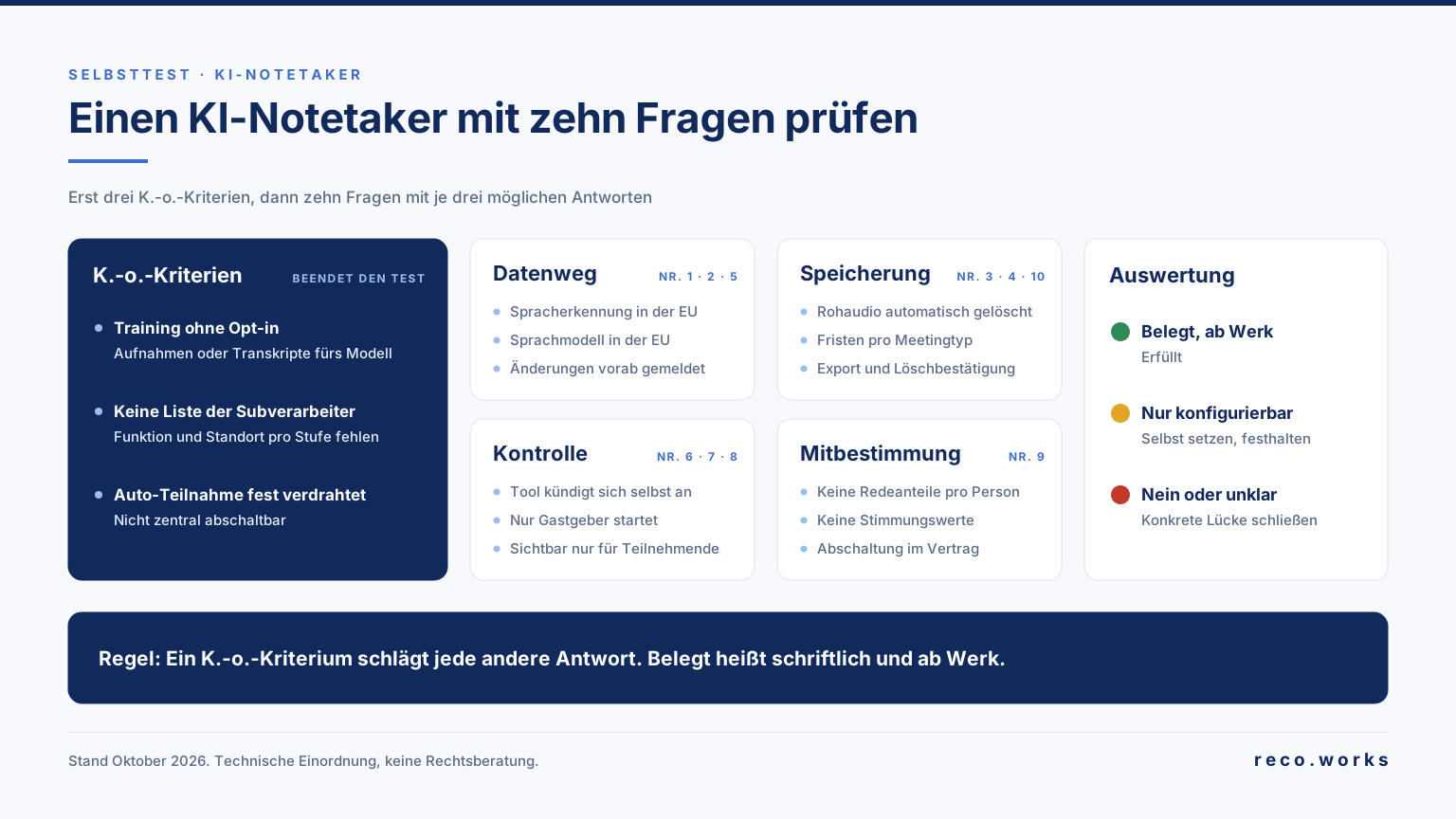
Three answers end the evaluation immediately. The vendor uses your recordings or transcripts for training without an explicit opt-in. It can't produce a list of sub-processors and their locations. Or auto-join can't be switched off centrally.
Every other question has three possible answers. Confirmed in writing and set that way by default. Configurable only, meaning it's right only once you've changed it. Or no, which includes any answer that stays vague.
- Speech recognition runs in the EU, or in the US only with an active DPF certification plus standard contractual clauses. An unclear location counts as no.
- The same goes for the language model that writes the summary.
- Raw audio is deleted automatically, at the latest a few days after the minutes are approved.
- Retention periods for transcripts can be set per workspace or meeting type.
- New sub-processors are announced in advance, with a right to object under Art. 28(2).
- The tool announces itself in the meeting, and individual participants can stop the recording.
- Only the person who sent the invitation can start recording, and outside bots can be blocked in your own tenant.
- Transcripts are visible only to participants by default, and public share links can be disabled.
- Performance-style analytics such as talk time or sentiment scores are absent or can be switched off.
- When the contract ends, you get a complete export and written confirmation of deletion.
There's no score above which you can roll out without a second thought, and I'm not going to pretend there is. Every no is a specific gap that you either close before rollout or consciously document as a residual risk. Every "configurable only" is a setting you make yourself, record in writing and re-check after major vendor updates. If the gaps pile up in questions 1 to 3, the data path and the raw recording, I wouldn't even pilot the tool, however impressive the demo was.
How well the transcription handles your dialects and jargon is a separate test, covered in Speech-to-text 2026.
At RECO, transcription and analysis run on EU servers with a dedicated server in Germany, and on-premises if you prefer. What we build on top of speech recognition is described on our AI conversation documentation page. Run the test on us anyway.
Send the ten questions to the vendor in writing before the next demo. How fast and how concretely the answers come back tells you almost as much as the answers themselves.
Sources
- Regulation (EU) 2016/679 (GDPR), in particular Art. 5, 13 and 28
- European Commission AI Act Service Desk: Article 50 (transparency obligations)
- Section 201 German Criminal Code: violation of the privacy of the spoken word
- Section 87 German Works Constitution Act: co-determination rights
- Corp-Intl: status of the EU-US Data Privacy Framework after Trump v. Slaughter, as of 11 September 2026
- European Commission AI Act Service Desk: Article 5 (prohibited practices)
- European Commission AI Act Service Desk: Article 111 (transitional provisions)
- European Commission AI Act Service Desk: Article 113 (entry into force and application)
- Section 96 Austrian Labour Constitution Act (ArbVG), RIS (in German)
- Section 96a Austrian Labour Constitution Act (ArbVG): replaceable consent, RIS (in German)
Frequently asked questions
Can I transcribe a meeting with AI if one participant objects?+
In practice, no, at least not with a recording. If the recording relies on consent, you don't have it for that person, and there's no audio track without their voice. In Germany, recording against someone's stated wishes would also raise Section 201 StGB. A clear fallback works best: no recording, one person writes short minutes by hand, and nobody has to justify saying no.
How long can you keep meeting transcripts?+
There's no fixed statutory period. What counts is storage limitation under Art. 5(1)(e) GDPR: as long as the purpose requires. I recommend three tiers: raw audio until the minutes are approved, full transcripts for a short fixed period that you tie to the purpose and can justify, and approved minutes for as long as the project records they belong to. Whatever periods you choose must appear in your privacy notice (Art. 13(2)(a)).
Is the built-in transcription of your video platform simpler from a data protection standpoint than a separate note-taker?+
Often yes, because you already have a data processing agreement with the platform provider and there's no extra bot in the call. The other questions stay the same: notice to all participants, co-determination, retention periods. Also check whether the AI summary is processed in the same region as the rest of your data. On some platforms that's a separate setting or a separate part of the contract.
Related articles
In a 30 minute conversation we'll discuss how and why RECO can grow your business now and into the future. Schedule a meeting now.