
Corporate memory: why your wiki isn't one, and how SMEs build one in six weeks
 Mag. Paul H. SchindlerCEO, RECOPublished 8 min read
At your next leadership meeting, ask why the company switched its main supplier a few years ago. Someone will usually remember the outcome. The reasons, the options that were turned down and the assumptions that made the decision right at the time are often known to one person. Sometimes to nobody. That gap, to me, is what corporate memory has to close. It records what was decided, why, by whom and under which conditions, and it keeps that record for years. A wiki, a document management system or an intranet stores documents. Ask any of them why, and you get silence.
My thesis will grate on anyone who has already lived through a wiki rollout. You can't build corporate memory as a documentation duty. It only comes into being as a by-product of the conversations in which decisions get made anyway. That's a usability question first and a technology question second.
The opposing view deserves a straight answer. Software teams have kept written decision logs for years, so-called architecture decision records, popularised by Michael Nygard in 2011. If developers can write down their decisions along with the reasoning, why can't a leadership team? And isn't recording meetings for this purpose overkill? I'll come back to both objections.
I'm leaving two related topics aside. How knowledge management works as a discipline is covered in knowledge management in the company. How to rescue critical knowledge before a key person leaves is the subject of knowledge retention in the company. This post is about something narrower that lasts longer, the memory for decisions.
What corporate memory holds that a wiki doesn't
Researchers have been at this for decades. In 1991, James Walsh and Gerardo Ungson described organizational memory in the Academy of Management Review as information from an organization's past that it can draw on when making decisions today. They named six places where it is retained, namely individuals, culture, processes and rules, the structure of roles, the physical workplace, and external archives such as former employees or consultancies. Information systems are missing from that list, which later authors criticised. For an SME, a different lesson is less comfortable. Most of the memory sits in the first location, in people's heads.
How large that share can be shows up in a 2018 survey that Panopto ran with YouGov among 1,001 employees of US companies with at least 200 staff. According to the results, 42 percent of institutional knowledge was unique to the individual. On average, respondents lost 5.3 hours a week waiting for information from colleagues or recreating knowledge that already existed. The figures are American. The mechanism travels.
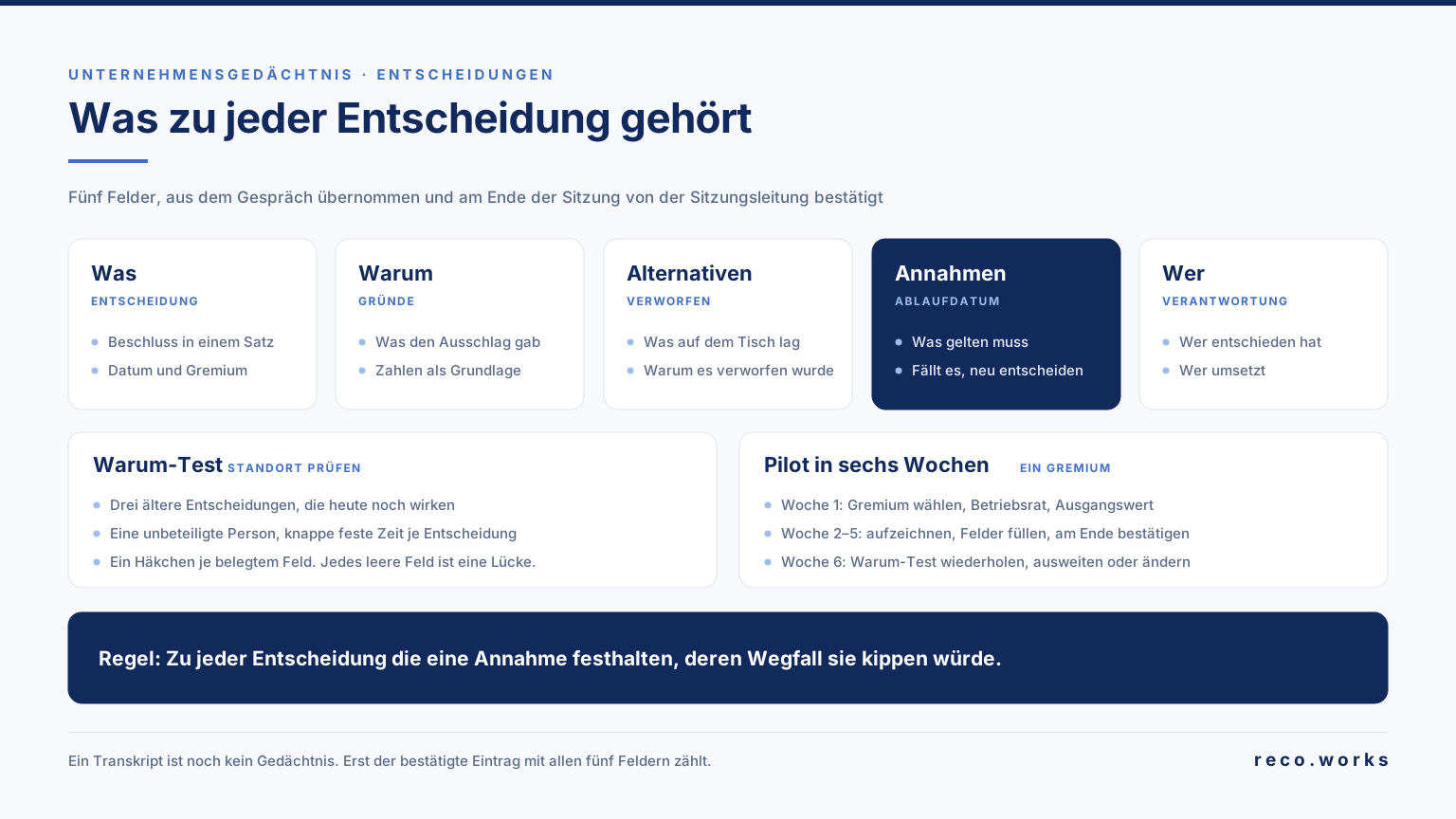
For a decision to be useful later, it needs more than a line in the minutes. I recommend five fields:
- What was decided, on which date, by which body?
- Why, meaning which reasons and figures tipped the balance?
- Which alternatives were on the table and rejected?
- Under which assumptions does the decision stay right?
- Who decided, and who carries it out?
The fourth field is the one most often skipped, and the most valuable. Assumptions are a decision's expiry date.
Why documentation duties fail
Whoever knows the reason behind a decision gains the least from writing it down. The benefit arrives two years later, for someone else, possibly for a person who hasn't joined the company yet. The effort arrives immediately, at the end of a meeting, with the next appointment already waiting. Every form, every mandatory field and every extra click competes with that next appointment. From a usability standpoint, the outcome is predictable. When one person carries the cost and another reaps the benefit, after a few weeks only the conscientious keep feeding the system.
Most organisations know the consequences. For its State of Teams 2025 report, Atlassian surveyed 12,000 knowledge workers and 200 executives. Teams, it found, spend a quarter of their time just searching for answers.
And architecture decision records? I think their structure is right; the five fields above borrow from it. They work in software teams because writing is part of the job there, the record sits next to the code and gets read in review. In a leadership meeting, the decision lands somewhere in the middle of a conversation, often in a subordinate clause. The format is rarely the problem. The input channel is. Pull the reasoning out of the conversation instead of chasing it afterwards, and you keep the format while dropping the extra work.
When the reason behind a rule disappears
A constructed example shows the mechanism. A manufacturer sets a minimum order size. Everyone knows why at the time. Each changeover on the main line takes a long time, and on small orders that eats the margin. A few years later a new line arrives that changes over much faster. A new head of sales wants to win back small customers and runs into the rule.
Without a memory, one of two things happens. Either the debate starts from scratch, with the same arguments and several meetings' worth of effort. Or the rule stays because it's the rule, even though its reason is long gone. If the original entry records the long-changeover assumption, one look is enough. The assumption no longer holds. So the company decides again, deliberately, without rerunning the old debate.
From this I draw one rule. For every important decision, record the one assumption whose collapse would overturn it. If you maintain only one field, make it this one.
The why test for your company
Finding out whether you lack corporate memory takes little effort. Pick three decisions that lie far enough back for the details to have faded in day-to-day work and that still shape how you operate, say a price change, a supplier switch and the design of a new role. Give someone who wasn't involved a short, fixed amount of time per decision, roughly what a normal working day leaves for looking something up. They get access to everything you have, from the shared drive and minutes to email and chat. For each of the five fields they can find evidence for, they tick a box. Asking colleagues doesn't count. Those colleagues may be gone tomorrow.
What you end up with is a table of three rows and five columns. Every empty cell is a specific gap. My expectation is that most companies do well on the what and come up nearly empty on the why and the assumptions. If those two columns are the empty ones, I wouldn't start with a tool. I'd start with a single meeting.
Building corporate memory in six weeks
For an SME with 50–500 employees, I'd keep the entry point deliberately small. One body, one type of meeting, a six-week pilot. Here's how I would go about it:
- In week 1, pick a meeting where decisions are made regularly, such as the weekly leadership meeting, the investment committee or the bid review. Settle the legal basis, how participants are informed and how the works council is involved before the first recording runs, and take the why test as your baseline.
- In weeks 2 to 5, the meetings are recorded and the decisions are pulled from the transcript into the five fields. The chair confirms or corrects the entries at the end of each meeting, as a fixed final agenda item. The pilot involves no other manual work.
- From week 4, a department head who doesn't sit in the meeting puts their questions to the memory instead of to management. Note which answers were missing.
- In week 6, repeat the why test with decisions from the pilot and decide whether a second body joins or the scope changes.
The six weeks are a frame, not a promise. Only the second why test shows whether a memory is taking shape.
I wouldn't skip the confirmation step. A transcript isn't a memory yet. It holds every tangent, every discarded idea and every joke. Only the confirmed decision with its five fields is an entry someone can rely on two years from now. HR matters and confidential items stay out of the recording, and you define that up front. The legal side is covered in documenting employee conversations.
I'm not neutral on this topic. At RECO we build a tool that turns recorded meetings into a searchable knowledge base, processed on EU servers and on-premises if you prefer. The Akademie für angewandte Zukunftsbildung (AAZB), which has trained coaches, consultants and trainers for more than ten years, captures its meetings, jour fixes and stand-ups this way, and 92 percent of its conversation content is now searchable. How this works technically is explained on the page about AI-supported conversation documentation. You can run the pilot with other tools too, as long as the five fields and the confirmation step stay. How a pilot becomes a company-wide habit is the subject of building a conversation culture in 90 days.
What the memory can't do
Decisions made in the corridor or in the car on the way to a customer won't end up in it. That will never fully change. If you want them to count, bring them to the next meeting and have them confirmed there. The past is missing at the start, too. For the most important older decisions, I recommend a short recorded conversation with the people who were in the room, while they're still with the company.
And the memory doesn't decide anything. It shows what a decision rested on, so the next one is better grounded. That matters more as more decision papers in your company are drafted with AI support, because each of those papers is only as good as the knowledge base underneath. More on that in AI in corporate decision making.
You already know the first question for your next leadership meeting. Why did we switch suppliers back then?
Sources
- Walsh, J. P. and Ungson, G. R.: Organizational Memory, Academy of Management Review 16 (1), 1991
- Florescu, M. and Ispas, R.-L.: A Literature Review on Organizational Memory from 1991 to 2021, International Management Conference, Bucharest 2022
- Panopto, press release of 17 July 2018: Workplace Knowledge and Productivity Report (with YouGov, 1,001 US employees)
- Atlassian: State of Teams 2025 (survey of 12,000 knowledge workers and 200 executives)
- Architectural Decision Records (ADR), overview including Michael Nygard, Documenting Architecture Decisions, 2011
Frequently asked questions
What is the difference between corporate memory and a knowledge base?+
A knowledge base is organised by topic and shows the current state. Whatever is outdated gets overwritten. Corporate memory is organised by time and keeps decisions that were later reversed, along with a pointer to the decision that replaced them. That chain is what explains why a company works the way it does today. In practice you need both, and a memory entry can link to documents in the knowledge base.
Is it legal to record meetings for a corporate memory?+
Yes, if the conditions are met. You need a legal basis under the GDPR, you have to inform participants in advance, and you need to set a retention period. If a system can capture employees' behaviour or performance, the works council has a say in Germany, and in Austria you will usually need a works agreement. I'd start with a leadership group whose members consent themselves and exclude HR matters from the outset. This is not legal advice; have your specific setup reviewed.
How long should recordings and decision entries be kept?+
Treat them separately. You only need the raw recording until the entries are confirmed; after a short period it can be deleted. Keep the confirmed decision entry for as long as the decision applies, and for a while afterwards, so it stays clear what replaced it. Both periods belong in the works agreement or internal policy before the pilot starts.
Related articles
The retirement wave hits mid-sized companies: how do you secure knowledge nobody ever wrote down?
Knowledge retention in the company: securing critical knowledge before key people leave
Knowledge management in the company: why most systems fail and what works instead
In a 30 minute conversation we'll discuss how and why RECO can grow your business now and into the future. Schedule a meeting now.