
The retirement wave hits mid-sized companies: how do you secure knowledge nobody ever wrote down?
 Mag. Paul H. SchindlerCEO, RECOPublished 4 min read
By 2040, around 13.3 million people in Germany's labour force will have passed the statutory retirement age of 67. That's 30 percent of the labour force (Federal Statistical Office, June 2026). In Austria, Statistik Austria expects the population aged 20 to 64 to shrink by around 256,000 by 2040. For your own company the average is only a rough benchmark. Better to count directly: check your HR records for who reaches statutory retirement age by 2040 and divide that number by the years remaining. That gives you departures per year. If your share is well above the 30 percent of Germany's labour force, your workforce is older than average. Usually only a few of these people are critical, but a lot depends on them.
My view: it is precisely the colleagues close to retirement who hold a large share of the operational knowledge. They know which supplier is reliable for which component, why a machine is set up differently from the manual and which customer responds to which wording in a quote. None of it is written down.
Unlike a resignation, a retirement comes with a known date. Yet knowledge transfer often starts only in the final weeks, between leftover holiday and ongoing projects, when nobody feels like documenting anything. That's the real mistake.
Why a manual is the wrong place to start
The obvious move is to have the experienced person write a manual. It's easy to delegate. I still think it's the wrong start. Experience is situational. Ask someone to write down everything important and you get generalities, because the real knowledge only surfaces in a concrete case. Ask the same person why they handled a particular order the way they did, and you get a precise answer with conditions no manual would contain.
Dorothy Leonard and Walter Swap called this deep smarts in the Harvard Business Review. It builds up over years and barely transfers through slides, reports or training. What works is guided practice alongside an experienced person. Several of our knowledge management articles look at why wikis and manuals alone don't close that gap.
A rhythm up to the last working day
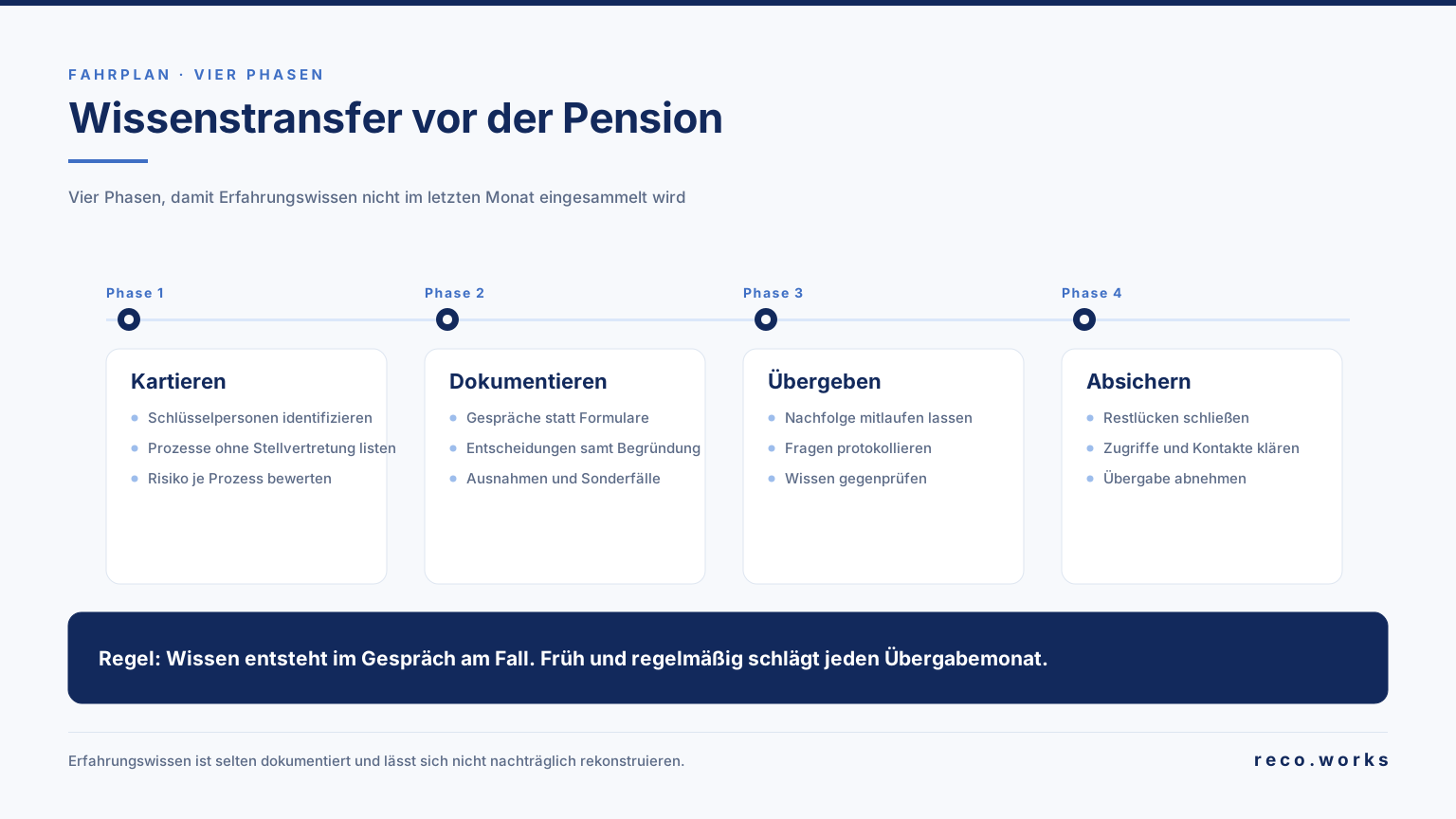
The workable route runs through conversations about real cases, and it starts as soon as the retirement date is set. Research does not name a fixed lead time either. The Fraunhofer IPK guide Wissen erfolgreich bewahren only states that more preparation time allows a more extensive transfer, and names a generous transition period with the position staffed twice as the safest route. Four building blocks are enough.
Tandem instead of handover
The successor works alongside instead of taking over afterwards. Working cases together regularly beats any handover plan. Workload decides how much of that is possible, but plan the time explicitly instead of squeezing it out of day-to-day business.
Record case discussions
In a fixed, recurring slot, the two go through cases that needed a decision. Record and analyse it, and over the months you build a searchable record of decisions and reasons, with nobody taking minutes. That's what AI-supported conversation documentation does today. Our speech-to-text comparison for 2026 covers how well transcription copes with dialect and jargon in German-speaking markets.
Our customer AAZB has trained coaches, consultants and trainers for more than ten years. That decade of training know-how is now documented, drawn from meetings and stand-ups, with no separate writing project.
Collect the exceptions
The normal case already lives in the ERP or the process manual. The value is in the exceptions, such as:
- late delivery of a component with no second supplier
- a complaint from a major customer
- a custom build outside the specification
- staff shortage at peak times
The real test before the farewell
Well before the experienced person leaves, the successor handles a real case alone while the experienced person only reviews it. Whatever goes wrong shows exactly which knowledge is still missing. It's uncomfortable and the most honest test you have.
Appreciation decides the outcome
People with decades of experience rarely hoard what they know. They don't pass it on because nobody asks, because there's no time, or because they worry about making themselves redundant. So I recommend defining the final stretch before retirement as a role of its own, explicitly as knowledge transfer with a lighter operational load. It costs budget. For what an unplanned departure costs, see What a key employee resignation really costs.
The four-column overview
To start, you need four columns:
- Who retires within your planning horizon?
- Which processes depend on that person?
- Is there a successor?
- Does documented reasoning knowledge exist?
A typical pattern: the top row is not necessarily whoever leaves first. Someone who alone knows how the oldest line is set up, has no successor and has documented nothing comes ahead of someone who leaves sooner but has a trained deputy. Every row with neither a successor nor documentation is your work programme for the coming year.
Sources
- Federal Statistical Office of Germany (Destatis), press release N039, 23 June 2026: 13.3 million members of the labour force reach statutory retirement age within 15 years
- Statistik Austria, press release of 12 November 2025: population projection (population aged 20 to 64 to 2040)
- Leonard, D. and Swap, W.: Deep Smarts, Harvard Business Review, September 2004
- Fraunhofer IPK (2016): Wissen erfolgreich bewahren (guide to systematically supported transitions of specialists and managers)
Frequently asked questions
How long should knowledge transfer before retirement take?+
There is no reliable minimum. The Fraunhofer guide on knowledge retention notes that the more preparation time there is, the more extensive the transfer can be. So start as soon as the successor is confirmed. If the retirement date is already close, compress the plan. Replace tandem days with more frequent case discussions and start with the list of exceptions. That secures the most critical cases, though not the whole role.
Why do manuals rarely work for knowledge transfer?+
They do work for the normal case: processes, system access, contacts. That part, however, should be written by the successor and checked by the experienced person. Someone new notices straight away where an explanation is missing. Someone with decades in the job skips exactly those spots.
Where should you start with the retirement wave?+
With the four-column overview, filled in jointly by management and HR. HR knows the retirement dates, management knows what the business depends on. If the exact date is missing for someone, ask them openly. That conversation is often the first step of the transfer itself.
Related articles
Corporate memory: why your wiki isn't one, and how SMEs build one in six weeks
Knowledge retention in the company: securing critical knowledge before key people leave
Knowledge management in the company: why most systems fail and what works instead
In a 30 minute conversation we'll discuss how and why RECO can grow your business now and into the future. Schedule a meeting now.