
Business succession: why your knowledge decides the sale price
 Mag. Paul H. SchindlerCEO, RECOPublished 8 min read
A prospective buyer sits in the data room and finds almost everything. Several years of balance sheets, the leases, the equipment finance, the org chart. None of these documents answers one question. How much of this revenue stays when the owner leaves?
Knowledge transfer in business succession comes down to that question. The costly departure describes how personal experience becomes a usable handover. In many owner-run companies only one person knows the answer. Unfortunately, it's the person who wants to sell. My argument is that undocumented owner knowledge is a valuation risk and belongs in the price negotiation, not in the final weeks before the keys change hands. The DIHK, the umbrella body of the German chambers of commerce, recommends starting concrete planning at least three years before the intended handover. In my view, knowledge transfer belongs in those same three years. If you put it off, you pay for it. Through a lower price, through an earn-out, or with your own time after the sale.
Many sellers see it differently. The buyer is purchasing figures, customers and market position, they argue, the knowledge can be handed over during the transition, and if need be they'll stay on as a consultant for a while. That can work. It just costs something, and hardly anyone works out how much. If you offer yourself as the handover solution, you make the value of your company depend on your continued presence.
Business succession in mid-sized companies, in numbers
KfW, the German development bank, published its SME succession monitor in January 2026. Through the end of 2029, around 109,000 mid-sized companies in Germany want a successor each year, 545,000 out of 3.87 million in total. In 2025, 57 percent of owners were 55 or older. Twenty years earlier the figure was 20 percent. For the first time, among businesses planning the owner's exit, slightly more plan to close than plan a succession, in absolute terms. Finding a suitable successor is seen as the biggest hurdle, with 69 percent naming it as an obstacle.
In Austria, according to the Austrian Economic Chamber (WKO), there were 8,202 business successions in 2025, a record high. By 2034, around 52,500 employer businesses with roughly 705,000 jobs are due for transfer. In 2021, the research institute KMU Forschung Austria studied how these handovers actually run. 58 percent took six months or less. Only 55 percent of sellers had a concrete handover plan. The experts interviewed considered it almost impossible to pass on a whole career's experience during the handover itself, and for family handovers they saw a three-year handover phase as the minimum.
Two figures from the DIHK succession report 2025 belong together, in my view. According to the chambers' advisers, 38 percent of retiring owners prepare too late, often only one or two years ahead, which the DIHK considers far too little. 36 percent expect an inflated price. I'd call that one problem, not two. The seller values the business as it runs today, with him in it. The buyer values the business as it will run without him.
Handing over a company and the knowledge no data room holds
What a buyer can't check usually falls into four groups.
- customer relationships that hinge on the owner, including promises, exceptions and goodwill rules nobody ever wrote down
- pricing logic, in other words why customer A gets a bigger discount than customer B for the same volume
- handshake deals with suppliers, such as payment terms, priority during shortages, or an annual bonus that exists only because of a long acquaintance
- unwritten rules inside the company, such as who makes which decision, which jobs you turn down, and which employee you ask about which problem
Columnist Kathrin Post-Isenberg, writing in the Deutsche Handwerks Zeitung, calls this the blind spot in every handover plan. Checklists capture contracts, figures and deadlines. What a business needs every day often isn't written anywhere. For SMEs, particularly trade businesses, documenting how the owner prices unusual jobs makes operational dependence visible before a sale. The WKO checklist for sellers does ask whether the successor has been introduced to customers, suppliers and staff. It doesn't ask how the knowledge behind those relationships gets passed on.
That holds for every type of handover, with a different emphasis. According to KfW, 55 percent of sellers would like a family solution, and 42 percent are considering a sale to an outsider. The daughter who takes over has known the business for years. In family and traditional businesses, knowledge preservation must capture the reasons behind longstanding customer exceptions, not just assume familiarity explains them. She still doesn't know why her father has postponed every price increase for one major customer for as long as anyone can remember. In a management buy-out, the managers know the processes but rarely the conversations at owner level. An external buyer? None of it.
How buyers price the risk
A buyer who spots heavy dependence on the owner has three tools. He lowers the price. He ties part of the purchase price to future revenue through an earn-out. Or he insists that the seller stays on under a consulting contract. All three push the risk back. To you. With an earn-out you pay if customers leave after you do; with a consulting contract you pay in time.
The best way to estimate what's at stake is with your own numbers. You need two inputs. The first is the share of revenue that depends on you alone, from the self-test below. The second is a value for the business, either your own asking price or the range from a valuation by your tax adviser. Multiply the two. The result isn't a discount a buyer deducts automatically. My view, though, is that this is the part of the price he'll negotiate first.
The KfW survey helps with the order of magnitude. Mid-sized sellers in Germany aim for a purchase price of 1.2 times annual revenue on average, and 0.6 times at the median. At the median, then, every euro of revenue stands for 60 cents of asking price, including every euro that runs only through you. These are sellers' expectations, not achieved prices. KfW therefore sets them against revenue multiples from the trade magazine FINANCE for small companies with less than 20 million euros in revenue, which range from 0.25 to 0.50 for construction and trades, for example, and from 0.30 to 0.55 for bricks-and-mortar retail.
I've described how private equity firms raise this question in due diligence, and why retention bonuses only postpone the problem, in the post on the Y Combinator call and key-person risk.
The self-test, your dependency ratio
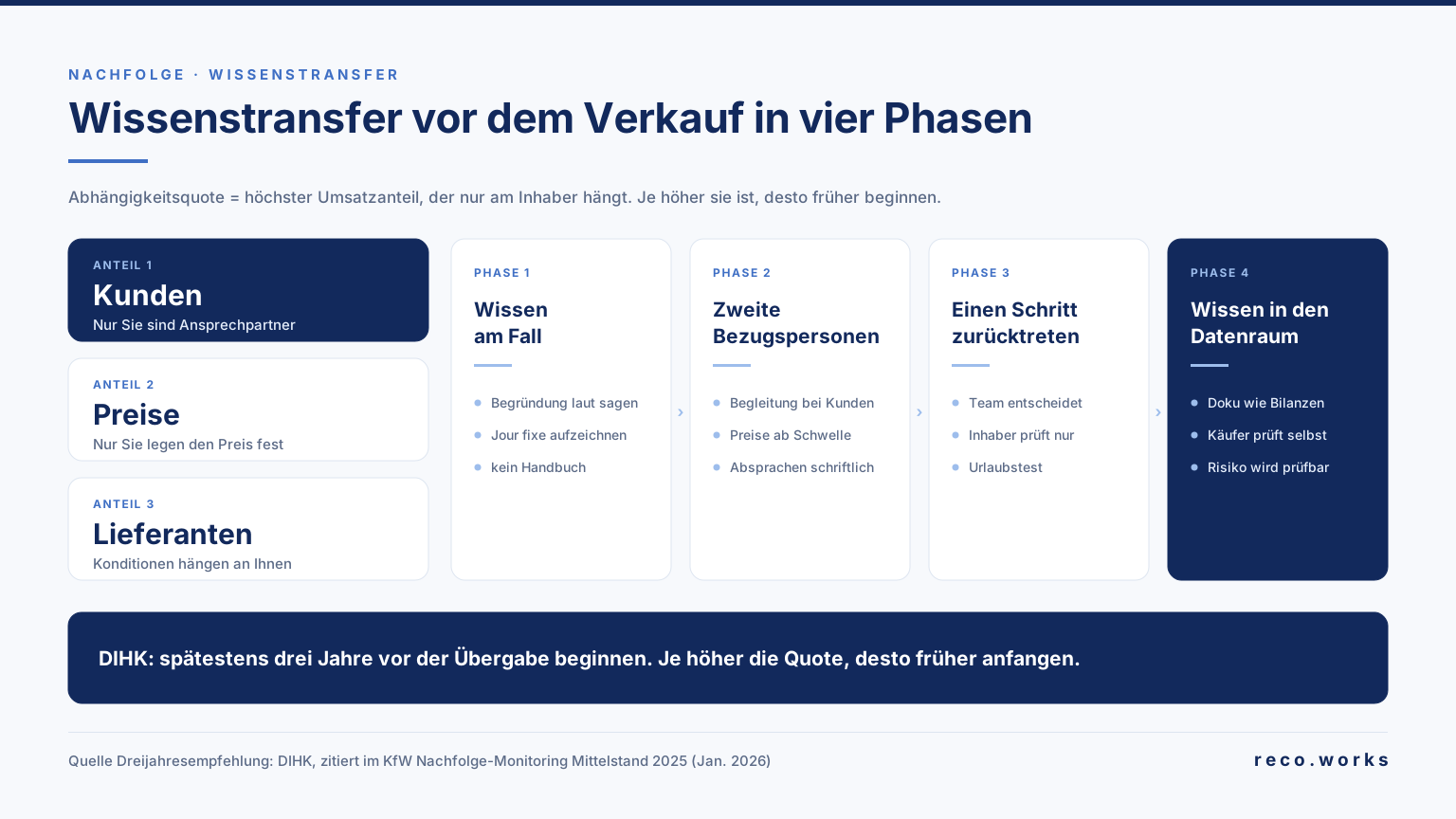
For a first estimate you need last year's revenue list and some honesty with yourself. Mark every customer for whom you are the only person they'd call when something goes wrong. Add up those customers' revenue. Do the same for quotes whose price only you set, and for supplier terms that would have to be renegotiated without you. The highest of the three shares is your dependency ratio.
I don't know of any study that sets a threshold where things become critical, and I'm not going to invent one here. The direction is clear all the same. The higher the ratio, the more relationships and decisions have to move to other shoulders, and customers and staff need time to get used to that. The DIHK's three years apply to every handover. With a high ratio I wouldn't go below them under any circumstances, and I'd rather start earlier. With a low ratio, more attention is left for tax, legal and financing. How to calculate the cost of a single key person whose knowledge disappears unplanned is shown in What it really costs when a key employee quits. The same calculation works for the owner, with his own customers and decisions as the input.
Preparing a business handover in four phases
This is how I'd go about it, with the DIHK's three years as the frame. The phases overlap, and how long each one takes depends on your ratio and your people. The order is what matters.
Phase one, make knowledge visible case by case
Don't write a manual. Experience comes out in a concrete case, when someone asks why you decided differently on that one order in March, and almost never on a blank page, as I've argued at length for retiring staff in the post on knowledge transfer before retirement. For an owner, that means saying the reasoning out loud when a decision is made. In the weekly jour fixe, in the pricing conversation, after the complaint. These conversations happen anyway. If they're recorded and analysed, over the months you build up a collection of decisions along with their reasons. I'm not neutral here, because with RECO we build knowledge transfer software for SMEs that makes exactly these meetings searchable, processed on EU servers with a dedicated server in Germany. A dictaphone and a disciplined assistant will also do the job.
Phase two, build second points of contact
Take a second person to every meeting with one of your key customers, and always the same person. From now on, prices above a fixed threshold are set by the second level; you only approve and explain why. Handshake agreements with suppliers get confirmed in writing. Some long-standing partners will find that unusual. For a buyer, it's the difference between a claim and a contract he can check.
Phase three, step back
The second level decides, and you only look over their shoulder. Towards the end of this phase, take the holiday test. Several weeks in a row, unreachable. Truly unreachable. Whatever goes wrong in that time shows you which knowledge is still missing. It's uncomfortable, and I think it's cheaper than any price adjustment.
Phase four, put knowledge in the data room
Put the documentation in the data room, just like the balance sheets. A buyer who can read how your pricing logic works and who looks after each major customer can assess the risk himself. He doesn't have to deduct it as a lump sum.
Start with the revenue list. If you want to hand over in three years, the DIHK's recommendation puts you at the latest sensible starting point right now, and phase one starts this quarter.
Sources
- KfW Research, Fokus Volkswirtschaft No. 526: SME succession monitor 2025, January 2026
- DIHK (Association of German Chambers of Commerce and Industry): succession report 2025
- KMU Forschung Austria: business transfers and successions in Austria, final report, August 2021 (commissioned by BMDW and WKO)
- Austrian Economic Chamber, Vorarlberg: new record in business successions, August 2026
- Post-Isenberg, K.: The blind spot in every handover plan (in German), Deutsche Handwerks Zeitung, August 2026
- WKO: checklist for sellers (in German)
Frequently asked questions
How long should the seller stay in the business after the sale?+
I recommend a short phase with a fixed end date and specific tasks, such as introductions to named customers, rather than an open-ended consulting role. According to KMU Forschung Austria, sellers stay involved after the handover in around two thirds of companies, mostly informally as advisers. The experts surveyed recommend agreeing in advance exactly how long the joint phase will last, and some even advise a clean break, so staff and customers can see who is in charge now. The further your knowledge transfer has progressed before the sale, the less this phase has to carry.
How is a business valued when it depends heavily on the owner?+
According to KfW, there is no generally accepted, uniformly used scheme for purchase prices. Industry-specific revenue multiples based on expert estimates or completed transfers offer a starting point. How much the business depends on its owner isn't captured in any multiple; that part gets negotiated. So have the valuation done by a tax adviser or M&A adviser and explicitly ask them to address owner dependency. That way you know the buyer's argument before he makes it.
When should you start planning a business succession?+
The DIHK recommends starting concrete planning and the search for a successor at least three years before the intended handover. For family handovers, the experts surveyed by KMU Forschung Austria recommend a planning period of three to five years. Legal form, tax and financing need their own lead time. Knowledge transfer works best in parallel with that work, not after it, because its results should feed into the valuation.
Related articles
In a 30 minute software demo we show you how RECO secures and transfers knowledge in your company. Request a demo now and we'll get back to you with a proposed time.