
Securing client knowledge: when accounts and relationships depend on one person
 Mag. Paul H. SchindlerCEO, RECOPublished Last edited 8 min read
A pattern many engineering and law firms will recognise: a project lead who has looked after the largest clients for years hands in her notice. Nothing changes in the CRM that day. Contracts, contacts, terms, it's all there. Yet over the next few weeks, conversations with exactly those clients start to feel awkward. Nobody knows that one client doesn't want calls first thing in the morning. Or what was promised verbally during the last change order.
The usual reflex after a departure like that is a CRM push: mandatory fields, notes after every meeting. I think that's well meant and the wrong priority. The CRM secures the facts, and the facts were never the problem. The valuable part of client knowledge is history, preferences and relationship, and hardly anyone types that into a form field. The lost deal focuses on retaining client commitments and preparing subsequent conversations. For SMEs, knowledge preservation therefore needs to capture why a client received an exception, not merely current contract terms. There are two ways to secure it. You spread it across a second person, and you record client conversations so that decisions and their reasons can be found again later. The costly departure explores what can be lost when the responsible colleague changes. The same approach supports knowledge transfer in property management companies, where handovers must carry verbal commitments and relationship history as well as formal records.
Why client knowledge is particularly sensitive in knowledge-intensive industries
Tax advisors, law firms, engineering offices and IT service providers don't sell products off a shelf. They sell judgment, experience and trust, and all of that sits with people.
In 1999, Morten Hansen, Nitin Nohria and Thomas Tierney described in the Harvard Business Review how consulting firms manage knowledge. They distinguish two strategies. Codification stores knowledge in databases. Personalisation passes it on through people and conversation. Firms selling tailored solutions, the authors found, rely mainly on personalisation. That works fine as long as the people stay. They don't always.
David Maister made the point in his 1993 standard work on professional service firms that client relationships in such firms are often tied more closely to the person than to the brand. In companies with 50–500 employees the effect is stronger, because there's rarely a dedicated team per client. More often there is one person in charge and someone helping out.
Then there's the money. Frederick Reichheld and Earl Sasser showed in 1990 that even small gains in customer retention raise profits disproportionately. The same logic runs in reverse. When a client leaves after a staff change, you lose more than a year's revenue. You lose every year that would have followed. For a rough way to put a number on a key person's knowledge, see calculating the cost of losing key employees.
The four levels of client knowledge
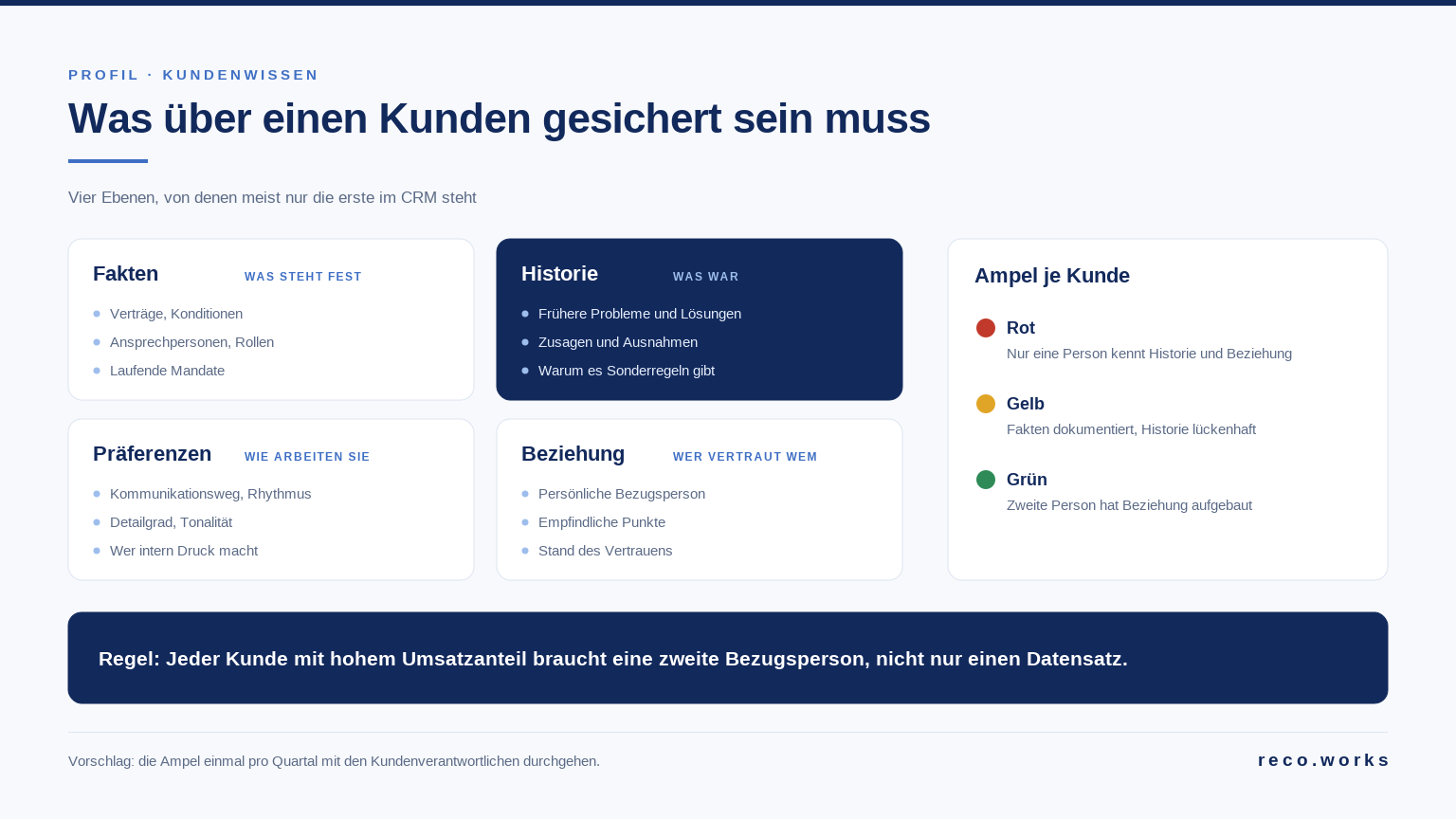
I split client knowledge into four levels. The scheme is deliberately simple, so a management team can apply it to its own clients in a single meeting.
Facts
Contracts, terms, contact persons, ongoing mandates or projects. This level lives in the CRM or practice management software and is usually well maintained. It's also the least valuable, because it's the easiest to rebuild. A new colleague can find it on day one.
History
What happened in the past and why. Which problems came up and how they were solved. Which commitments were made that aren't written down anywhere. Why this client pays a different hourly rate. When a successor makes mistakes in the first months that the client reads as a lack of respect, this is often where they come from. Someone who doesn't know about a quiet exception and "corrects" it is following the rules and still annoys the client.
Preferences
How the client likes to work. Phone or email, weekly or as needed, detailed documents or a one-page summary. And who on the client side is pushing internally, even if their name isn't on the signature line.
Relationship
Who trusts whom, where the sore points are, how solid the relationship is right now. Nonaka and Takeuchi would call this tacit knowledge, the kind that's hard to put into words. That's why this level can only be documented up to a point, and I think that's how it should be. What you can do is spread it across more than one person.
A traffic light per client
I suggest giving every important client a traffic-light colour once a quarter. To keep it from becoming a gut call, answer five yes-or-no questions for each client:
- Does anyone besides the account owner know the most important special arrangements?
- Has a second person had their own meeting with the client in the last twelve months?
- Is it written down anywhere why the client's terms differ from the standard?
- Does anyone besides the account owner know who really makes decisions on the client side?
- Could someone read up on the gist of the last major conversation with the client?
Every question you answer with no is a concrete gap. You don't need a points scale for the colour. A client is red if the first two questions already come out as no, because then nobody but one person really knows that client. A client is green only when all five answers are yes. Everything in between is yellow. Start with your highest-revenue clients and work down from there.
The traffic light only becomes meaningful next to revenue, and the arithmetic is simple. Take each client's fee or project revenue for the last financial year from your accounts and divide it by total revenue. Write that share next to the colour. Then add up the shares of all red clients, separately for each account owner. The result is the part of your revenue that hangs on a single resignation. Client groups that your accounts list as several clients but that run through the same contact person count as one client here. I find that sum more telling than any CRM report. It also sets the order. The red client with the largest revenue share is the first to get a second contact, with their own meeting at the client.
Five measures for everyday practice
- A second contact for every important client. A deputy who exists only in the org chart doesn't count. The second person needs their own regular meetings with the client, even when nobody needs covering.
- Record client conversations in a way that keeps decisions and rationales searchable later. Minutes filed away won't do that. With AI-supported conversation documentation it happens without extra writing, provided the client agrees. At the AAZB, an academy that has trained coaches and trainers for more than ten years, 92 percent of conversation content is now searchable this way. Those are internal meetings, but the mechanism carries over to client conversations.
- A regular internal client briefing, for example as part of annual planning. The person responsible tells a colleague the client's story, no slides. When people tell a story, they remember things they'd never write down.
- Treat history as its own block when an account changes hands. Every handover should ask which exceptions and commitments exist. More on this in our guide to securing knowledge in the company.
- Build client knowledge into succession planning. Anyone looking after a lot of red clients belongs on the list of critical roles, wherever they sit in the org chart.
Legal considerations
Client knowledge includes personal data, and in law and tax firms it also includes information covered by professional confidentiality. Record who has access to what, and get consent from everyone involved before recording conversations. How this fits with data protection rules and works councils is covered in the article on documenting employee conversations. The same principles carry over to client conversations. This section is general orientation, not legal advice.
Why this matters for AI as well
If you're planning AI assistants for 2027 that draft proposals or answer client requests, they'll draw on the same data your people use. If the system only holds the facts level, the assistant writes answers that are correct but wrong for the client. It might send the client with the agreed special rate a proposal at list price. That's why securing client knowledge is also part of your AI readiness.
A small first step
In knowledge-intensive industries, client knowledge is working capital, even though it shows up on no balance sheet. My suggestion for getting started is a small one. Put the five questions for your highest-revenue clients on the agenda of your next management meeting and write a name next to every red one. Then a departure costs you time, not the client. To get a sense of what it costs your company when a key person's knowledge walks out the door, try the knowledge loss calculator.
Sources
- Hansen, M. T., Nohria, N. and Tierney, T.: What's Your Strategy for Managing Knowledge?, Harvard Business Review, March/April 1999
- Reichheld, F. F. and Sasser, W. E.: Zero Defections, Quality Comes to Services, Harvard Business Review, September/October 1990
- Maister, D. H.: Managing the Professional Service Firm, Free Press, 1993
- Nonaka, I. and Takeuchi, H.: The Knowledge Creating Company, Oxford University Press, 1995
Frequently asked questions
What is client knowledge?+
Everything a firm knows about a client, from contracts to the personal relationship. It differs from CRM data in that most of it isn't written down anywhere. A quick way to see how much of it your firm has documented is to ask what a successor could read up on about the client on day one.
How do you secure client knowledge when someone resigns?+
If the notice is already in, use the notice period for joint client meetings with the successor, not just for handover documents. Every meeting the successor attends transfers part of the relationship. Set aside a separate session to ask about special arrangements, verbal commitments and the reasons behind non-standard terms, because none of that is in any document.
Which industries are most affected?+
Knowledge-intensive service firms such as tax advisors, law firms, engineering offices, consultancies and IT providers. Firms with 50–500 employees are especially exposed when one partner or project lead looks after several large clients alone and there's no dedicated team per client.
Related articles
Corporate memory: why your wiki isn't one, and how SMEs build one in six weeks
The retirement wave hits mid-sized companies: how do you secure knowledge nobody ever wrote down?
Knowledge retention in the company: securing critical knowledge before key people leave
In a 30 minute software demo we show you how RECO secures and transfers knowledge in your company. Request a demo now and we'll get back to you with a proposed time.